SAVE Is Ending: How Much More Will Your Student Loan Payment Be Under RAP?
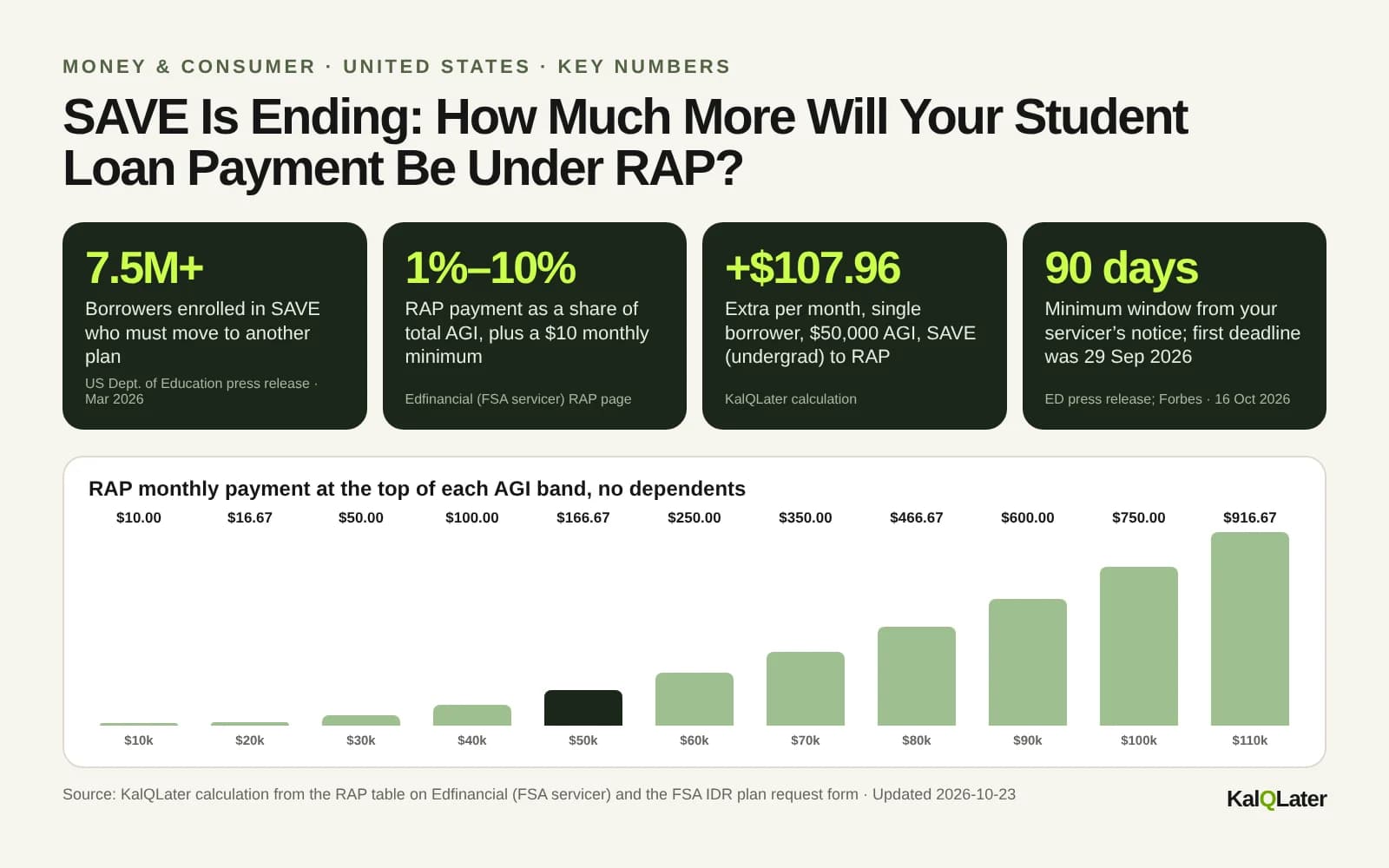
For many SAVE borrowers the new payment is close to three times higher: a single borrower with a $50,000 AGI and undergraduate loans goes from $58.71 a month under SAVE to $166.67 under RAP. SAVE ignored income below 225% of the poverty line; RAP charges 1% to 10% of total AGI, minus $50 per dependent, with a $10 minimum. Borrowers get at least 90 days from their servicer’s notice to choose, or are moved to a fixed Standard plan.

The short answer: RAP costs more than SAVE for almost everyone
In all eight income cases we modeled, RAP costs more than SAVE, from $10 to $489 a month more. The gap is largest for single borrowers with only undergraduate loans, who had SAVE’s 5% rate. RAP is still far cheaper than the 10-year Standard plan for low and middle incomes, which is where you land if you do nothing.
SAVE was the most generous income-driven plan the Education Department ever offered. It shielded income up to 225% of the federal poverty guideline and charged 5% of the rest on undergraduate loans. That shield is why a single borrower earning $30,000 paid $0 a month.
The Repayment Assistance Plan (RAP), created by the One Big Beautiful Bill Act (P.L. 119-21) and available since 1 July 2026, has no income shield. It takes a percentage of your total adjusted gross income (AGI), from 1% at $10,001 to 10% above $100,000, then subtracts $50 a month per dependent. The same $30,000 single borrower now pays $50 a month.
Our verdict: the headline ‘payments will jump’ is true, but the size depends heavily on household size. A family of three on $50,000 pays $0 under SAVE and $66.67 under RAP. A single borrower on $100,000 pays $267.04 under SAVE and $750 under RAP, which is more than the $397.42 Standard payment on a $35,000 balance. Use the calculator above for your own numbers.
SAVE vs RAP calculator: your new student loan payment
Enter your adjusted gross income, family size, dependents and loan details to see your monthly payment under the Repayment Assistance Plan (RAP), the 10-year Standard plan, and what you were paying under SAVE, which is ending. Estimates only; your servicer calculates the official amount.
- RAP monthly payment (estimate)
- $166.67
- SAVE monthly payment (ending — comparison only)
- $58.71
- Standard 10-year payment
- $397.42
- RAP costs more than SAVE by
- $107.96 / month · $1,295.50 / year
- First month: unpaid interest waived
- $22.92
- First month: government principal match
- $50.00
If you don't choose a plan by your servicer's deadline (at least 90 days plus a final 30-day notice), you are placed in a fixed Standard plan. Parent PLUS loans cannot use RAP. SAVE estimate uses the 48-state 2026 poverty guideline. Estimates only; not financial advice.
Why is the SAVE plan ending?
SAVE is ending because of a court settlement between the Education Department and Missouri, on top of a law that already repealed it. The One Big Beautiful Bill Act, signed 4 July 2025, closed SAVE, PAYE and ICR by 1 July 2028. The settlement pulled that forward to 2026 for SAVE borrowers.
SAVE has been frozen by litigation since a June 2024 court ruling. The Education Department put SAVE borrowers into a zero-interest forbearance, then restarted interest on 1 August 2025 (not retroactively), according to its July 2025 press release. At that point the department said it was contacting “nearly 7.7 million borrowers” enrolled in SAVE.
On 9 December 2025, the department and Missouri announced a proposed settlement: stop new SAVE enrollments, deny pending applications, and move everyone still on SAVE into other plans. A district judge dismissed it in late February 2026; the Eighth Circuit reversed that dismissal in early March and told the court to enter judgment, NASFAA reported on 11 March 2026.
In late March 2026 the department announced next steps: servicers would start notifying the “more than 7.5 million borrowers” in SAVE on 1 July, and each borrower would get “at least 90 days” to pick a legal plan. The department, which calls the 2025 law the Working Families Tax Cuts Act, estimated SAVE would have cost more than $342 billion over 10 years.
SAVE plan deadline: every key date from 2025 to 2028
The date that matters most is the one on your own servicer notice: you have at least 90 days from it, plus a final 30-day notice. For borrowers notified on 1 July 2026, the first deadline was 29 September 2026. Servicers send notices in waves and must reach every SAVE borrower before the end of 2026.
| Date | What happens | Source |
|---|---|---|
| 4 Jul 2025 | One Big Beautiful Bill Act signed; creates RAP and repeals ICR authority (which covers SAVE and PAYE) from 1 Jul 2028 | ED press release; CRS R48727 |
| 1 Aug 2025 | Interest restarts on SAVE loans in forbearance (no retroactive interest) | ED press release, Jul 2025 |
| 9 Dec 2025 | ED and Missouri announce proposed settlement to end SAVE early | NPR / Michigan Public |
| Jan 2026 | ED sends the first wage garnishment notices, then on 16 Jan delays all involuntary collections | Scripps News; ED press release |
| Early Mar 2026 | Eighth Circuit reverses dismissal of the settlement | NASFAA, 11 Mar 2026 |
| Late Mar 2026 | ED announces SAVE borrowers will get at least 90 days to switch from 1 Jul | ED press release (page reviewed 27 Mar 2026) |
| 1 Jul 2026 | RAP and Tiered Standard plan launch; servicers begin SAVE notices; new loan limits start | ED; Edfinancial; CRS R48727 |
| 29 Sep 2026 | First 90-day deadline, for borrowers notified 1 Jul | Forbes, 16 Oct 2026 |
| 30 Sep 2026 | Defaulted Loans Support Center portal launches | IBTimes, 20 Oct 2026 |
| Oct 2026 | Final 30-day notices sent to borrowers who missed their 90-day window | Forbes, 16 Oct 2026 |
| By 31 Dec 2026 | Every SAVE borrower notified | Forbes, citing ED |
| 15 Apr 2027 | Reported, unconfirmed target for restarting collections | IBTimes, 20 Oct 2026 |
| 1 Jul 2027 | Borrowers may rehabilitate a defaulted loan twice instead of once | CRS R48727 |
| 1 Jul 2028 | ICR and PAYE end; borrowers who don’t choose are enrolled in RAP | CRS R48727; NY Attorney General |
Your SAVE forbearance does not end on one national date. Under the July 2026 process, each servicer tells each borrower when their forbearance will end, the New York Attorney General’s office said in a 6 July 2026 consumer alert.
How is the Repayment Assistance Plan payment calculated?
RAP takes a flat percentage of your whole AGI, from 1% to 10%, divides it by 12, subtracts $50 per dependent and never goes below $10. The percentage applies to all income, not just the slice inside the band, so crossing a $10,000 line raises the whole payment.
| Annual AGI | Base payment | Monthly at top of band |
|---|---|---|
| Up to $10,000 | $120 a year | $10.00 |
| $10,001–$20,000 | 1% of AGI | $16.67 |
| $20,001–$30,000 | 2% of AGI | $50.00 |
| $30,001–$40,000 | 3% of AGI | $100.00 |
| $40,001–$50,000 | 4% of AGI | $166.67 |
| $50,001–$60,000 | 5% of AGI | $250.00 |
| $60,001–$70,000 | 6% of AGI | $350.00 |
| $70,001–$80,000 | 7% of AGI | $466.67 |
| $80,001–$90,000 | 8% of AGI | $600.00 |
| $90,001–$100,000 | 9% of AGI | $750.00 |
| Over $100,000 | 10% of AGI | $833.34 at $100,001 |
RAP monthly payment at the top of each AGI band, no dependents
Source: KalQLater calculation from the RAP table on Edfinancial (FSA servicer) and the FSA IDR plan request formView the data
| Label | Value |
|---|---|
| $10k | $10.00 |
| $20k | $16.67 |
| $30k | $50.00 |
| $40k | $100.00 |
| $50k | $166.67 |
| $60k | $250.00 |
| $70k | $350.00 |
| $80k | $466.67 |
| $90k | $600.00 |
| $100k | $750.00 |
| $110k | $916.67 |
The cliff effect is real. At an AGI of exactly $50,000 the rate is 4% and the payment is $166.67. One dollar more, at $50,001, moves you to 5% and $208.34 a month, an extra $41.67. Contributing to a traditional 401(k) or HSA lowers AGI and can drop you a band.
Married borrowers who file jointly are assessed on combined AGI. Filing separately counts only your own income and dependents, according to the Edfinancial RAP page. Parent PLUS loans and consolidation loans that include a Parent PLUS loan cannot use RAP.
RAP vs SAVE vs Standard: how much more will you pay?
On a $35,000 balance at 6.5%, a single borrower on $75,000 goes from $162.88 (SAVE, undergrad) to $437.50 under RAP, an extra $274.62 a month or $3,295 a year. The 10-year Standard payment is $397.42 regardless of income.
| AGI · household | SAVE undergrad (5%) | SAVE grad (10%) | RAP | Standard 10-yr | RAP vs SAVE undergrad |
|---|---|---|---|---|---|
| $30,000 · single | $0.00 | $0.00 | $50.00 | $397.42 | +$50.00 |
| $50,000 · single | $58.71 | $117.42 | $166.67 | $397.42 | +$107.96 |
| $75,000 · single | $162.88 | $325.75 | $437.50 | $397.42 | +$274.62 |
| $100,000 · single | $267.04 | $534.08 | $750.00 | $397.42 | +$482.96 |
| $30,000 · family of 3 | $0.00 | $0.00 | $10.00 | $397.42 | +$10.00 |
| $50,000 · family of 3 | $0.00 | $0.00 | $66.67 | $397.42 | +$66.67 |
| $75,000 · family of 3 | $56.38 | $112.75 | $337.50 | $397.42 | +$281.12 |
| $100,000 · family of 3 | $160.54 | $321.08 | $650.00 | $397.42 | +$489.46 |
Extra monthly payment moving from SAVE (undergrad) to RAP, single borrower
Source: KalQLater calculation using 2026 HHS poverty guidelines and the RAP tableView the data
| Label | Value |
|---|---|
| $30k AGI | $50.00 |
| $50k AGI | $107.96 |
| $75k AGI | $274.62 |
| $100k AGI | $482.96 |
Two results stand out. First, low earners still pay little under RAP: the family of three on $30,000 owes the $10 minimum. Second, higher earners with modest balances can find RAP more expensive than the Standard plan. The single borrower on $100,000 would pay $750 under RAP versus $397.42 on a 10-year schedule; for them a fixed plan is the cheaper choice.
Does RAP stop your balance from growing?
Yes, if you pay on time: RAP waives any interest your payment doesn’t cover and adds up to $50 a month toward principal. That means the balance falls every month, even on a $10 payment, which SAVE’s interest subsidy did not guarantee.
Two rules make RAP gentler than the payment figures suggest. If your payment is less than the month’s interest, the unpaid interest is not charged. And if a full, on-time payment reduces principal by less than $50, the Education Department makes a matching principal payment, so principal falls by at least what you paid, up to $50.
Worked example (KalQLater): a $35,000 balance at 6.5% accrues $189.58 of interest a month. The single borrower on $30,000 pays $50. The $50 covers part of the interest, the remaining $139.58 is waived, and the government adds $50 to principal. The balance drops from $35,000 to $34,950 in month one.
The trade-off is time. RAP forgives any remaining balance only after 360 qualifying payments (30 years), versus 20 or 25 years under SAVE. Forgiven balances may be taxable income; Scripps News notes that federal student loan forgiveness became taxable again from 2026.
What happens if you don’t choose a new student loan plan?
If you ignore your notice, you are moved to a fixed Standard plan, which is $397.42 a month on a $35,000 balance at 6.5% regardless of income. Borrowers who miss the 90-day window first get a final 30-day notice, about 120 days in total.
The Education Department says borrowers who do not pick a plan within the window are placed in the Standard Repayment Plan or the Tiered Standard Plan. For our single borrower on $30,000, that means a jump from $0 under SAVE to $397.42, not to $50 under RAP.
Forbes reported on 16 October 2026 that the department is now sending ‘final notices’ to borrowers who missed their first deadline. It cited a borrower with about $80,000 at 6.8%, a $60,000 income and two dependents: roughly $920 a month on the 10-year Standard plan versus about $150 to $200 under RAP. Our calculator gives $920.64 and $150.00 for that case.
Are student loan delinquencies and wage garnishment coming back?
Delinquencies spiked after credit reporting restarted and are now easing: the annualized flow into serious delinquency fell from 16.19% in Q4 2025 to 7.83% in Q2 2026. Wage garnishment and tax-refund seizures remain paused as of 23 October 2026, with no official restart date.
Student loans: annualized flow into serious delinquency (90+ days), % of balance
Source: Federal Reserve Bank of New York, Quarterly Report on Household Debt and Credit (releases May 2025 to Aug 2026)View the data
| Label | Value |
|---|---|
| Q3 2024 | 0.77% |
| Q4 2024 | 0.70% |
| Q1 2025 | 8.04% |
| Q2 2025 | 12.88% |
| Q3 2025 | 14.26% |
| Q4 2025 | 16.19% |
| Q1 2026 | 10.86% |
| Q2 2026 | 7.83% |
The share of all student debt that is 90+ days delinquent was under 1% at the end of 2024, 7.74% in Q1 2025, 9.6% in Q4 2025 and 10.3% in Q1 2026, per the New York Fed. Total student debt was $1.651 trillion in Q2 2026.
On collections, the timeline has flip-flopped. The department began mailing wage garnishment notices in January 2026 (Scripps News reported 1,000 so far, with up to 15% of pay at risk), then on 16 January delayed both Administrative Wage Garnishment and the Treasury Offset Program while it implemented the new plans. As of IBTimes’ 20 October 2026 report, no restart date had been announced; officials reportedly weighed the 15 April 2027 tax deadline. Defaults are still reported to credit bureaus.
Does RAP count for Public Service Loan Forgiveness?
Yes. On-time RAP payments count as qualifying PSLF payments under section 82004 of the 2025 law, so forgiveness after 120 payments (10 years) still applies. SAVE’s court-ordered forbearance does not produce qualifying payments, which is why the department told PSLF borrowers to switch out of SAVE.
The Congressional Research Service confirms RAP is a PSLF-qualifying plan and that the act made no other PSLF changes. Qualifying payments already earned carry over when you switch plans.
For public servants, a lower payment is usually better because anything left after 120 payments is forgiven. Compare RAP with Income-Based Repayment, which uses income above 150% of the poverty guideline. New PSLF regulations also took effect on 1 July 2026; the Edfinancial RAP page says they have no current impact on payment counts or discharges.
How to switch from SAVE to RAP or another plan
Find the deadline on your servicer notice, run the numbers, and apply for a plan on StudentAid.gov before it passes. Choosing RAP or IBR yourself almost always beats being moved to the Standard plan by default.
- 1Find your notice
Log in to your servicer account and look for the SAVE transition email or letter. It gives your personal 90-day deadline and when your forbearance ends.
- 2Gather your AGI
Use line 11 of your latest federal tax return (Form 1040). Count dependents claimed on that return; each one cuts the RAP payment by $50.
- 3Compare plans
Use our calculator above, then StudentAid.gov’s Loan Simulator. If RAP is higher than the Standard payment, a fixed plan may be cheaper.
- 4Apply online
Submit the Income-Driven Repayment Plan Request on StudentAid.gov and choose RAP or IBR. Applications for RAP opened 1 July 2026. Allow consent to pull your tax data so you don’t have to recertify by hand.
- 5If you can’t pay at all
Call your servicer before the deadline. Consumer advocates suggest asking about temporary forbearance or deferment; a $10 RAP payment is usually better than missing payments.
- 6Already in default?
Contact the Default Resolution Group about rehabilitation or consolidation now, while involuntary collections remain paused.
- Your AGI is under about $60,000 or you have dependents
- You are pursuing PSLF
- You want unpaid interest waived and a falling balance
- Your income is high relative to your balance
- RAP would exceed the Standard payment
- You want to be debt-free in 10 years, not 30
Claims vs evidence
“SAVE borrowers face much higher payments under RAP”
Our modeled cases show increases of $10 to $489 a month; the single $50,000 borrower pays $107.96 more.
True“All SAVE borrowers had to switch by the end of September 2026”
Only borrowers notified on 1 July had a 29 Sep deadline. Notices go out in waves through 2026, each with at least 90 days plus a final 30-day notice.
Misleading“If you do nothing you go into RAP”
For SAVE borrowers now, ED places non-responders in a Standard or Tiered Standard plan. Automatic RAP placement applies to ICR/PAYE loans from 1 July 2028.
False“Wage garnishments have restarted”
Notices began in January 2026, but ED delayed AWG and Treasury offsets on 16 Jan 2026. No restart date as of 23 Oct 2026.
False“RAP payments start at $10 a month”
The minimum is $10, and AGI of $10,000 or less pays exactly $10. Dependents can also reduce a payment to the $10 floor.
True“RAP ends PSLF for SAVE borrowers”
RAP payments qualify for PSLF under section 82004 of P.L. 119-21.
FalseFrequently asked questions
When does the SAVE plan end?
SAVE is being wound down borrower by borrower. Servicers began sending notices on 1 July 2026, each with at least 90 days to choose a new plan, followed by a final 30-day notice. ED says every SAVE borrower will be notified by the end of 2026. The law removes SAVE from the books entirely on 1 July 2028.
How is the RAP payment calculated?
Find your AGI band: 1% of AGI at $10,001 to $20,000, rising one point per $10,000, to 10% above $100,000. Divide by 12, subtract $50 per dependent, and pay at least $10. An AGI of $50,000 with no dependents gives 4% × $50,000 ÷ 12 = $166.67 a month.
What happens if I miss the SAVE deadline?
You get a final 30-day notice. If you still don’t choose, ED places you in the Standard or Tiered Standard plan, which ignores income. On a $35,000 balance at 6.5%, the 10-year Standard payment is $397.42 a month. You can usually change plans later.
Is RAP better than IBR?
It depends on income and family size. IBR uses income above 150% of the poverty guideline, so it can be lower for families with modest incomes, while RAP waives unpaid interest and adds up to $50 a month to principal. IBR remains available for loans made before 1 July 2026. Compare both in the Loan Simulator.
Does RAP qualify for PSLF?
Yes. Under section 82004 of the One Big Beautiful Bill Act, on-time RAP payments count toward the 120 qualifying payments for Public Service Loan Forgiveness. Payments you already made under other qualifying plans still count after you switch.
Is student loan wage garnishment happening in 2026?
Not as of 23 October 2026. The Education Department delayed Administrative Wage Garnishment and Treasury refund offsets on 16 January 2026 and has not announced a restart date. Reports point to possible restarts in 2027. Defaults are still reported to credit bureaus.
Can RAP be more than the Standard payment?
Yes, for higher earners with smaller balances. A single borrower with a $100,000 AGI pays $750 a month under RAP, versus $397.42 on a 10-year Standard plan for a $35,000 balance at 6.5%. In that case a fixed plan costs less each month.
How many people are on the SAVE plan?
The Education Department said more than 7.5 million borrowers were enrolled in SAVE in March 2026, down from nearly 7.7 million in July 2025. At least 1.2 million had left SAVE by 1 July 2026, according to department data cited by Forbes.
How we built this analysis
- RAP: monthly payment = max($10, base ÷ 12 − $50 × dependents), where base = $120 if AGI ≤ $10,000, otherwise AGI × band rate (1% for $10,001–$20,000 up to 10% above $100,000), applied to total AGI. Table from the Edfinancial (FSA servicer) RAP page and FSA’s IDR plan request form.
- SAVE (for comparison): max(0, (AGI − 2.25 × poverty guideline) × rate ÷ 12), rate 5% for undergraduate loans and 10% for graduate loans, weighted by original principal if mixed. Poverty guideline = $15,960 + $5,680 × (family size − 1), the 2026 HHS figure for the 48 states and DC (Federal Register, 15 Jan 2026).
- Standard 10-year: P × r ÷ (1 − (1 + r)^−120), r = annual rate ÷ 12. For $35,000 at 6.5%: $397.42. For $80,000 at 6.8%: $920.64.
- Worked cases assume a $35,000 balance at 6.5%, single = household of 1 with no dependents, family of 3 = two dependents. Example: $75,000 single SAVE undergrad = ($75,000 − $35,910) × 5% ÷ 12 = $162.88; RAP = 7% × $75,000 ÷ 12 = $437.50; difference $274.62 a month, $3,295 a year.
- Delinquency chart uses the New York Fed’s ‘flow into serious delinquency’ for student loans, annualized, from five quarterly press releases (May 2025 to August 2026).
- Dates were cross-checked against Education Department press releases, CRS report R48727, the New York Attorney General, NASFAA and dated news reports; where only news reports exist (deadlines in waves, collections status), we say so.
Limitations
RAP and SAVE amounts are estimates. Servicers use your tax-return AGI and certified family size, and married couples filing jointly are assessed on combined income. We use the 48-state poverty guideline; Alaska and Hawaii have higher guidelines that would lower SAVE payments. We do not model IBR, the Tiered Standard plan’s 10 to 25-year terms, tax on forgiveness, or the full RAP principal-match over time. There is no official count of borrowers still in SAVE or of RAP enrollments as of 23 October 2026, and the collections restart date is unannounced. This is not financial, tax or legal advice.
Spotted an error? See our corrections policy. Read how we work in our methodology and editorial standards.
Sources
- US Department of EducationU.S. Department of Education Announces Next Steps for Borrowers Enrolled in the Unlawful SAVE Plan7.5M+ SAVE borrowers, 90-day window from 1 Jul 2026, default placement
- US Department of EducationContinues to Improve Federal Student Loan Repayment Options, Addresses Illegal Biden Administration ActionsInterest resumes 1 Aug 2025; nearly 7.7M SAVE borrowers; PSLF advice
- US Department of EducationDelays Involuntary Collections Amid Ongoing Student Loan Repayment ImprovementsAWG and Treasury Offset delay, Jan 2026
- Edfinancial (Federal Student Aid servicer)Repayment Assistance Plan (RAP)RAP AGI band table, $10 minimum, $50 per dependent, subsidies
- Federal Student AidIncome-Driven Repayment Plan Request formRAP base payment table; IBR uses 150% of poverty guideline
- Edfinancial (Federal Student Aid servicer)SAVE PlanSAVE formula: 225% of poverty line, 5%/10% weighted
- Congressional Research ServiceThe Repayment Assistance Plan (RAP) in P.L. 119-21 (IF13075)RAP rules, 360-payment forgiveness, principal match
- Congressional Research ServiceAmendments to the Higher Education Act Made by P.L. 119-21 (R48727)PSLF section 82004, 1 Jul 2028 phase-out, Tiered Standard, rehabilitation
- Federal Register (HHS)Annual Update of the HHS Poverty Guidelines (2026)$15,960 for one person, +$5,680 per person
- Federal Reserve Bank of New YorkHousehold Debt and Credit, Q2 2026 press release7.83% flow into serious delinquency; $1.651T balance
- Federal Reserve Bank of New YorkHousehold Debt and Credit press releases, Q1 2025 to Q1 2026Quarterly flow and 90+ share; also releases of 13 May 2025, 5 Nov 2025, 10 Feb 2026
- New York State Attorney GeneralAttorney General James Urges Student Loan Borrowers on SAVE Plan to Choose New Plan6 Jul 2026 consumer alert; forbearance end dates per servicer
- NASFAANew FSA Data Shows 1.3 Million Uptick in Defaulted Borrowers~9M in default at 31 Mar 2026; FSA Data Center
- ForbesEducation Department Sends Student Loan Borrowers ‘Final Notices’ With Ominous Warning29 Sep deadline, final 30-day notices, 1.2M left SAVE
- Scripps News / IBTimes / NPRMillions of student loan borrowers face new repayment rules as garnishments restartJan 2026 garnishment notices; see also IBTimes 20 Oct 2026 and NPR 9 Dec 2025 on the settlement