AI Layoffs 2026: Is AI Really Cutting 10,000 Jobs a Month?
On average, yes: US employers cited AI for 120,136 announced job cuts in January–September 2026, or about 13,350 a month, according to Challenger, Gray & Christmas. But the pace is lumpy. AI cuts peaked at 38,579 in May and fell below 4,000 in both August and September. Even at the average pace, that is 0.08% of the 159 million US payroll jobs, and the overall layoff rate has not risen.

The short answer: real, but much smaller than the headline suggests
AI is being blamed for more layoffs than ever, about 13,350 announced US job cuts a month in 2026, but it is not yet visible in the official layoff rate. The 10,000-a-month figure in the news is a model estimate of slower job growth, not a count of pink slips, and the most recent months are well below it.
Two Fortune stories this week put AI job losses back in the headlines. One quoted Pantheon Macroeconomics saying AI is causing US job losses “in excess of 10,000 roles per month.” The other reported a Goldman Sachs note saying that up to 9% of workers could be displaced over the AI transition, roughly one in 11.
We checked those claims against the three data sets that actually measure job losses: Challenger, Gray & Christmas’s monthly count of announced job cuts (which records the reason employers give), the Bureau of Labor Statistics JOLTS survey of actual layoffs, and the BLS unemployment rate. The picture is clear. AI has become the number one stated reason for announced US job cuts in 2026, but it is a small slice of a very large labour market, and overall layoffs are no higher than in 2024.
This article looks at layoffs across the whole economy. For the narrower question of programmers, see our analysis Is AI Actually Replacing Software Jobs?.
Where does “AI is killing 10,000 jobs a month” come from?
The 10,000 figure is an economists’ estimate of how far job growth in AI-exposed sectors is running below trend, not a count of people fired. Three different measures get quoted as if they were the same thing, and they are not.
According to Fortune (23 October 2026), Pantheon Macroeconomics economists Samuel Tombs and Oliver Allen track sectors exposed to AI and estimate losses of more than 10,000 roles a month. They note that construction jobs are rising as data centres are built, while accounting, advertising, office administration and legal services are “slowly disappearing.” Fortune gives no further detail on the method.
Goldman Sachs economist Joseph Briggs makes a similar point in his October note: job growth in the most AI-exposed industries has run about 10,000 below its long-run trend over the past three months, but that has been roughly offset by AI-related construction hiring. A Crypto Briefing summary of an earlier Goldman report put the net drag at about 16,000 a month, later revised to about 11,000 by June 2026.
| Figure | Source | What it measures | Type |
|---|---|---|---|
| 10,000+ a month | Pantheon Macroeconomics (via Fortune, 23 Oct 2026) | Estimated net job shortfall in AI-exposed sectors | Model estimate |
| ~10,000 a month below trend | Goldman Sachs, J. Briggs (via Fortune, 22 Oct 2026) | Job growth gap in AI-exposed industries, offset by data-centre construction | Model estimate |
| 13,348 a month (2026 average) | Challenger, Gray & Christmas | Announced job cuts where the employer named AI as the reason | Count of announcements |
| 9% of workers | Goldman Sachs, J. Briggs | Possible temporary displacement over the whole AI transition (years) | Long-run scenario |
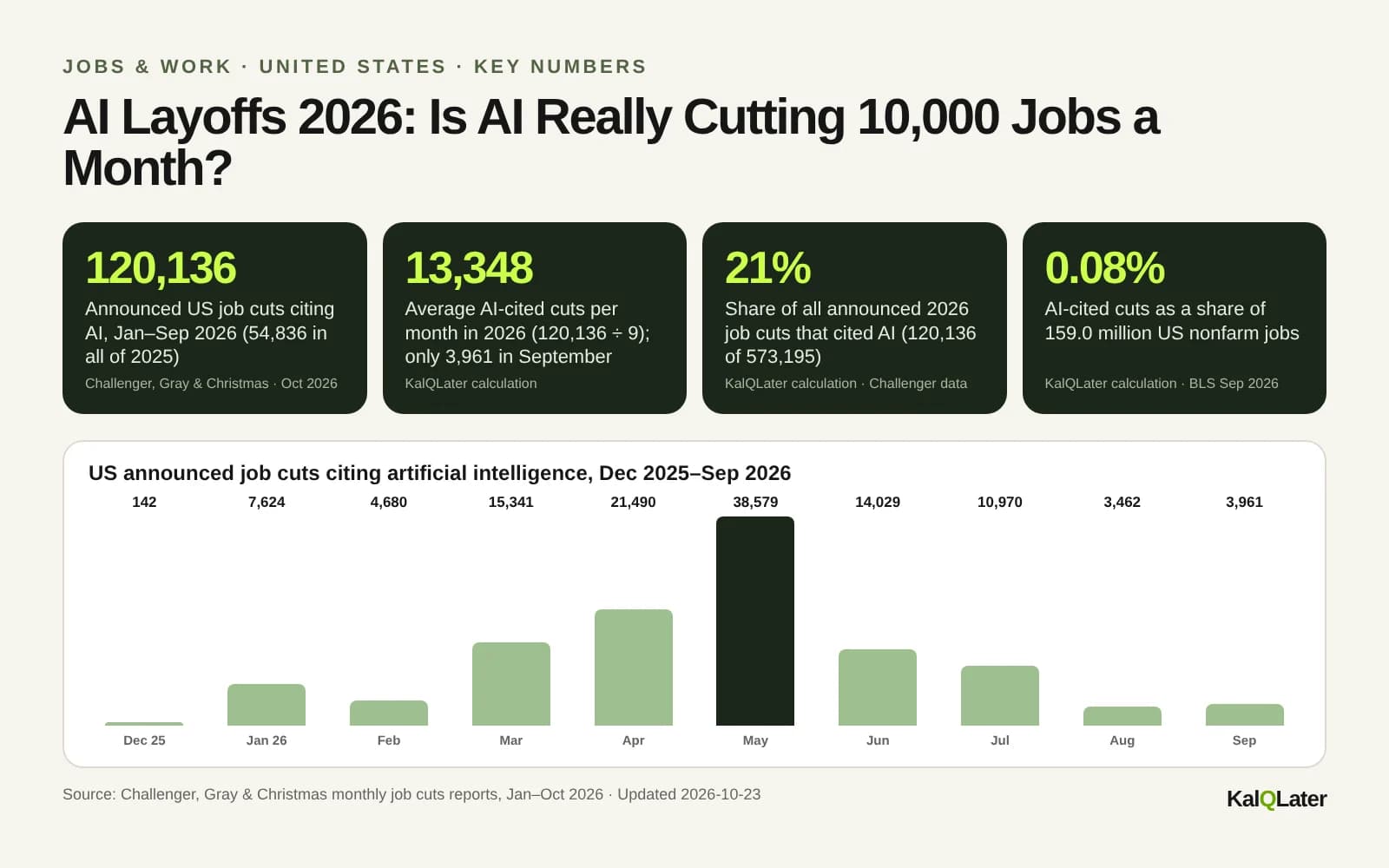
How many job cuts were blamed on AI each month in 2026?
AI-cited job cuts went from 142 in December 2025 to a record 38,579 in May 2026, then fell to 3,462 in August and 3,961 in September. Five of the nine months in 2026 were above 10,000; the last two were well below it.
US announced job cuts citing artificial intelligence, Dec 2025–Sep 2026
Source: Challenger, Gray & Christmas monthly job cuts reports, Jan–Oct 2026View the data
| Label | Value |
|---|---|
| Dec 25 | 142 |
| Jan 26 | 7,624 |
| Feb | 4,680 |
| Mar | 15,341 |
| Apr | 21,490 |
| May | 38,579 |
| Jun | 14,029 |
| Jul | 10,970 |
| Aug | 3,462 |
| Sep | 3,961 |
AI was the leading reason for job cuts for five straight months, from March to July 2026. In August it dropped to fourth place, its lowest total since December 2025, and in September it was fifth. Year to date it is still the top reason, ahead of “market and economic conditions” (114,124) and closings (99,092).
The 2026 total of 120,136 is already more than double the 54,836 AI-cited cuts in all of 2025. Since Challenger started tracking AI in 2023, the cumulative total is 191,961 (KalQLater sum of the 71,825 to end-2025 plus 120,136 in 2026).
AI’s share of all announced US job cuts, by month, 2026
Source: KalQLater calculation from Challenger, Gray & Christmas monthly totalsView the data
| Label | Value |
|---|---|
| Jan | 7.0% |
| Feb | 9.7% |
| Mar | 25.3% |
| Apr | 25.8% |
| May | 39.8% |
| Jun | 30.6% |
| Jul | 32.8% |
| Aug | 6.5% |
| Sep | 9.2% |
Are US layoffs actually rising because of AI?
No. The US layoffs and discharges rate was 1.0% in August 2026, exactly where it was in January 2024, and it has stayed between 0.9% and 1.2% throughout. Unemployment was 4.2% in September 2026, below its 4.5% peak in November 2025.
US layoffs and discharges rate, Jan 2025–Aug 2026 (% of employment)
Source: BLS Job Openings and Labor Turnover Survey (JOLTS), series JTSLDR via FREDView the data
| Label | Value |
|---|---|
| Jan 25 | 1.1% |
| Feb 25 | 1.2% |
| Mar 25 | 1.0% |
| Apr 25 | 1.1% |
| May 25 | 1.1% |
| Jun 25 | 1.2% |
| Jul 25 | 1.1% |
| Aug 25 | 1.2% |
| Sep 25 | 1.1% |
| Oct 25 | 1.2% |
| Nov 25 | 1.0% |
| Dec 25 | 1.1% |
| Jan 26 | 1.0% |
| Feb 26 | 1.1% |
| Mar 26 | 1.2% |
| Apr 26 | 1.0% |
| May 26 | 1.1% |
| Jun 26 | 1.1% |
| Jul 26 | 1.1% |
| Aug 26 | 1.0% |
The August 2026 JOLTS release (29 September) showed 1.6 million layoffs and discharges, “little changed” from July. Hires were 5.2 million and job openings 7.1 million. Total announced job cuts in Challenger’s data are actually down 39% year to date (573,195 vs 946,426), mainly because 2025 included almost 294,000 cuts tied to federal DOGE actions.
US unemployment rate, Jan 2025–Sep 2026
Source: BLS Current Population Survey, series UNRATE via FREDView the data
| Label | Value |
|---|---|
| Jan 25 | 4.0% |
| Mar 25 | 4.2% |
| May 25 | 4.3% |
| Jul 25 | 4.3% |
| Sep 25 | 4.4% |
| Nov 25 | 4.5% |
| Dec 25 | 4.4% |
| Jan 26 | 4.3% |
| Mar 26 | 4.3% |
| May 26 | 4.3% |
| Jul 26 | 4.1% |
| Aug 26 | 4.1% |
| Sep 26 | 4.2% |
Where the labour market is weak is hiring, not firing. Payrolls grew just 29,000 in September 2026 and by an average of about 68,000 a month since December 2025 (KalQLater calculation from BLS payroll levels). Long-term unemployed people made up 27.1% of the 7.1 million jobless. Andy Challenger described employers as being in a “wait-and-see period,” citing energy costs, the war in Iran, a possible rate rise and healthcare costs. He did not mention AI.
Which companies cut the most jobs because of AI in 2026?
Oracle (21,000 over 12 months), HSBC (up to 20,000 reported), Amazon (16,000) and Meta (about 8,000) are the largest 2026 job cuts linked to AI. But in most cases AI is one reason among several, and some firms explicitly deny that AI replaced the workers.
| Company | Jobs cut | When | AI link as stated | Source |
|---|---|---|---|---|
| Oracle | 21,000 over 12 months (13%) | Jun 2026 | Filing says AI adoption “may continue to result” in reductions | TechCrunch, citing SEC filing |
| HSBC | About 20,000 (~10%) over 3–5 years, under consideration | Mar 2026 (report) | CEO betting on AI to shrink middle and back offices | Bloomberg via Fox Business; HSBC declined to comment |
| Amazon | 16,000 corporate (after 14,000 in Oct 2025) | 28 Jan 2026 | Cited cutting layers; Jassy said gen AI would reduce corporate headcount | TechCrunch / CNBC |
| Meta | About 8,000 (10%) | May 2026 | Tied to AI competition; ~7,000 moved into AI roles | TechCrunch |
| Microsoft | About 4,800 (2.1%) | Jul 2026 | Said roles were not replaced by AI | TechCrunch |
| Dow | About 4,500 (13%) | 29 Jan 2026 | Automation and AI | Reuters factbox |
| PayPal | Over 4,500 (20%) over 2–3 years | May 2026 | Turnaround centred on AI adoption | TechCrunch |
| Block | 4,000 (nearly half) | Feb 2026 | Smaller teams using AI “intelligence tools” | TechCrunch, citing Jack Dorsey |
| Cisco | Nearly 4,000 (~5%) | May 2026 | Resources realigned toward AI, silicon and security | TechCrunch |
| Intuit | About 3,000 (17%) | May 2026 | Reallocating resources toward AI | TechCrunch |
HSBC’s cuts are a medium-term plan reported by Bloomberg, not a confirmed figure. In October the Financial Times reported separate “deep” cuts in HSBC’s UK wealth business tied to its AI push, with no total given. Amazon’s further October 2026 cuts were fewer than 1,000 roles and the company did not link them to AI.
The headline “103,000 job cuts in AI restructuring” from FourWeekMBA could not be opened during our research, so we have not used its total. Our table uses only announcements we could trace to a filing, the company or a named news report.
Will AI really displace 1 in 11 workers, as Goldman Sachs says?
Goldman’s 9% is a long-run scenario, not a forecast for 2026: it assumes AI eventually lifts productivity by 15% and spreads displacement over the whole transition. Briggs expects the bulk of AI layoffs to wait for the next recession.
In his October 2026 note, Joseph Briggs estimates that if AI raises productivity by 15%, up to 9% of workers could be temporarily displaced, with slower hiring weighing on employment by another 3%. He has previously described the 9% as about 15 million workers over a decade. In August 2025 he and Sarah Dong put displacement at 6–7%, within a 3–14% range.
The recession argument is historical. The share of Americans in routine jobs held steady during expansions but fell in steps during the early-1980s, 2001, 2008 and 2020 recessions, and never recovered. Companies tend to automate when they are under pressure to cut costs. Briggs notes that the US economy has been resilient in 2026 and only 23% of US establishments have built AI into regular workflows.
Goldman also looked at 25 occupations hit by earlier technologies, such as file clerks, proofreaders and bank tellers. Employment in them fell 25% on average over five years once decline began. Briggs calls this a likely upper bound for AI, and says even the 9% scenario would add less than one percentage point a year to unemployment.
Which jobs are most exposed to AI?
Office, administrative, legal-support, accounting and customer-service roles are the most exposed, while construction is gaining from AI data-centre building. The IMF estimates about 60% of jobs in advanced economies are exposed to AI, but roughly half of those may benefit rather than shrink.
- Pantheon Macroeconomics Accounting, advertising, office administration and legal services are “slowly disappearing”; construction is rising with data-centre work (via Fortune, Oct 2026).
- Goldman Sachs Past technology shocks hit routine clerical jobs hardest. Separation rates rose in 19 of 25 disrupted occupations and hiring rates fell in 13. Earlier Goldman research flagged technology, management consulting, graphic design and customer service.
- IMF (January 2024) Almost 40% of global employment is exposed to AI, about 60% in advanced economies, 40% in emerging markets and 26% in low-income countries. Around half of exposed jobs could gain productivity; for the other half, AI could reduce demand, wages and hiring.
- OECD (Employment Outlook 2023) Occupations at the highest risk of automation make up 27% of employment across OECD countries. At the time it found little evidence that AI had yet had a significant effect on jobs.
- Challenger industry data Technology leads 2026 job cuts with 165,925, followed by transportation (44,430) and health care/products (37,417). Challenger also says AI is the main reason cited for chemical-sector cuts this year.
Is AI hurting entry-level and young workers most?
The clearest AI effect so far is fewer openings for young workers, not mass layoffs of experienced staff. Stanford researchers found a 13% relative drop in employment for 22- to 25-year-olds in the most AI-exposed occupations, while older workers in the same jobs held steady.
The Stanford study by Erik Brynjolfsson, Bharat Chandar and Ruyu Chen (August 2025) used payroll records. It found the decline was concentrated in occupations where AI automates work rather than augments it, and that the adjustment came through fewer jobs rather than lower pay. The result held even after excluding tech firms.
The New York Fed’s data point the same way. In the second quarter of 2026, the unemployment rate for recent college graduates aged 22–27 “stayed elevated at about 5.6 percent,” above the 4.2% national rate, and 42% of recent graduates were underemployed in jobs that do not require a degree.
Briggs also says recent data show “some signs of AI-related hiring headwinds.” That fits Goldman’s finding that disrupted occupations typically see hiring fall as well as separations rise. For a job seeker, a missing vacancy feels very different from a layoff, but it never shows up in a layoff count. Our remote jobs 2026 analysis shows how crowded applications have become.
Are AI layoffs happening in the UK and elsewhere?
The biggest non-US AI-linked cuts are in banking and insurance, led by HSBC, but official statistics outside the US do not yet track AI as a layoff reason. UK unemployment was 4.7% in June–August 2026, down 0.1 points on the year.
The ONS labour market bulletin of 20 October 2026 does not mention AI. It shows payrolled employees down 66,000 (0.2%) on the year to September 2026, at 30.3 million, and vacancies down 5.1% on the year to 691,000. That is a cooling market, but there is no official way to attribute it to AI.
Company announcements outside the US that cited AI include Swedish bank SEB (up to 2,100 jobs by 2027), Australian software firm WiseTech (about 2,000, nearly a third of staff), Allianz travel insurance (up to 1,800, according to a source), and Telstra (650), according to a Reuters factbox from February 2026. We could not find a Canadian or German official series that records AI as a reason; for Canada’s latest figures see our Canada job losses analysis.
What can workers do about AI job cuts?
The data say the risk is concentrated in routine, entry-level office tasks and is likely to rise in a recession, so the best time to prepare is while the labour market is still stable. These steps follow from the evidence above.
- 1Check how routine your tasks are
List your weekly tasks and mark which are repeatable drafting, data entry, summarising or scheduling. Goldman and Stanford both find displacement where AI automates tasks, not where it assists judgement.
- 2Become the person who runs the AI
Augmenting occupations held up in the Stanford data. Learn the AI tools your employer is buying and volunteer for the pilot, so you are the one using them rather than being measured against them.
- 3Build a 3- to 6-month cash buffer
Goldman expects AI-driven layoffs to cluster in the next downturn, and 27.1% of the US unemployed have already been jobless for over six months. Savings buy time to retrain instead of taking the first offer.
- 4Watch your employer’s spending signals
Challenger’s data show cuts often follow budget shifts to AI infrastructure. Big capex announcements, hiring freezes and “flattening layers” language are early warnings.
- 5Lean toward judgement and in-person work
Andy Challenger says workers will need decision-making and judgement. Physical, regulated and client-facing roles, including the construction trades benefiting from data-centre building, are the least exposed.
- 6If you are starting out, get experience any way you can
Entry-level roles are where hiring is weakest. Internships, apprenticeships and contract work count, and recent graduates face a 42% underemployment rate, so a non-graduate job is not a failure.
AI layoffs: claims vs evidence
“AI is killing 10,000-plus jobs per month.”
Pantheon’s figure is a model estimate of net job losses in AI-exposed sectors. Challenger’s count of AI-cited announced cuts averages 13,348 a month in 2026, but was under 4,000 in August and September.
Partly true“9% of jobs are at risk from AI right now.”
Goldman’s 9% is a scenario for the whole AI transition assuming a 15% productivity gain, described by Briggs as temporary displacement over many years (about 15 million over a decade).
Misleading“AI is now the top reason for US layoffs.”
True for announced cuts: AI leads Challenger’s 2026 reasons with 120,136 (21%). But that is about 0.8% of all actual layoffs recorded by the BLS.
Partly true“AI is causing a wave of layoffs across the economy.”
The BLS layoffs and discharges rate was 1.0% in August 2026, the same as January 2024, and unemployment fell from 4.5% to 4.2%.
False“AI layoffs will spike in the next recession.”
Goldman’s historical work shows routine jobs fall in steps during recessions. Plausible, but no recession has started to test it.
Too early“AI is hitting young and entry-level workers hardest.”
Stanford finds a 13% relative employment drop for 22–25-year-olds in AI-exposed jobs; recent-grad unemployment is about 5.6% vs 4.2% overall.
TrueFrequently asked questions
How many jobs has AI replaced in 2026?
US employers cited AI as the reason for 120,136 announced job cuts from January to September 2026, according to Challenger, Gray & Christmas. That is more than double the 54,836 in all of 2025. These are announced cuts where AI was the stated reason, not a verified count of jobs taken over by AI.
Is AI really cutting 10,000 jobs a month?
On average, roughly yes for announced cuts: 13,348 a month in 2026. But the monthly figure ranged from 3,462 in August to 38,579 in May. The widely quoted 10,000 figure is a Pantheon Macroeconomics estimate of job shortfalls in AI-exposed sectors, not a count of layoffs.
What percentage of layoffs are caused by AI?
AI was cited for 21% of all announced US job cuts in January–September 2026 (Challenger). Compared with all actual US layoffs and discharges recorded by the BLS, about 13.8 million in January–August, AI-cited cuts are about 0.8% (KalQLater calculation).
What did Goldman Sachs say about AI and jobs?
Goldman economist Joseph Briggs estimates that if AI lifts productivity by 15%, up to 9% of workers, about one in 11, could be temporarily displaced over the transition. He expects most of those losses to come during the next recession and says the yearly unemployment impact would be under one percentage point.
Which companies cut jobs because of AI in 2026?
The largest AI-linked cuts include Oracle (21,000 over 12 months), HSBC (about 20,000 reported as under consideration), Amazon (16,000), Meta (about 8,000), Dow (about 4,500), PayPal (over 4,500), Block (4,000), Cisco (nearly 4,000) and Intuit (about 3,000). In many cases AI was one of several reasons.
Which jobs are most at risk from AI?
Routine office roles are most exposed: administration, accounting, legal support, advertising and customer service. The IMF says about 60% of jobs in advanced economies are exposed to AI, but roughly half of those may benefit. Construction is currently gaining from AI data-centre building.
Is the US unemployment rate rising because of AI?
Not so far. US unemployment was 4.2% in September 2026, down from 4.5% in November 2025, and the layoffs rate was 1.0% in August 2026. Goldman estimates AI-exposed industries are about 10,000 jobs a month below trend, roughly offset by data-centre construction hiring.
Are entry-level jobs disappearing because of AI?
There is evidence of fewer openings. Stanford researchers found a 13% relative drop in employment for 22- to 25-year-olds in the most AI-exposed occupations. The New York Fed reports recent college graduates had about 5.6% unemployment and 42% underemployment in Q2 2026.
How we built this analysis
- AI-attributed job cuts come from Challenger, Gray & Christmas monthly reports (January–September 2026 and the 2025 year-end report). Monthly figures were taken from each report; the nine months sum exactly to Challenger’s published year-to-date total of 120,136.
- Monthly average: 120,136 ÷ 9 = 13,348. Annualised pace: 13,348 × 12 = 160,181. Share of announced cuts: 120,136 ÷ 573,195 = 21.0%. Monthly AI shares divide each month’s AI cuts by that month’s total cuts.
- Share of actual layoffs: AI-cited cuts January–August 2026 (116,175) ÷ BLS JOLTS layoffs and discharges for the same months (13,814,000, sum of seasonally adjusted monthly levels) = 0.84%.
- Share of employment: 120,136 ÷ 159,044,000 total nonfarm payroll jobs (BLS, September 2026) = 0.076%; 159,044,000 ÷ 13,348 = one in about 11,900 jobs a month.
- Goldman pace check: 9% × 159.044 million = 14.3 million; 14.3 million ÷ 13,348 = about 1,072 months (89 years). 15 million ÷ 120 months = 125,000 a month, 9.4 times the 2026 average.
- Company table includes 2026 announcements where the company, a filing or a named report linked cuts to AI; figures are as announced or reported, and multi-year plans are labelled.
Limitations
Challenger records announced cuts and the reason employers give; companies may label budget cuts as AI (or avoid mentioning AI), announcements may be phased over years, and some include non-US staff. JOLTS counts actual layoffs but records no reason, so no official US statistic measures AI-caused job loss. Pantheon and Goldman monthly figures are model estimates. Exposure scores (IMF, OECD) estimate what share of tasks AI could do, not job losses. The FourWeekMBA “103,000 job cuts” total could not be opened and is not used. Figures are as of 23 October 2026; the October Challenger report is due in early November. This article is general information, not career or financial advice.
Spotted an error? See our corrections policy. Read how we work in our methodology and editorial standards.
Sources
- Challenger, Gray & ChristmasJob Cuts Fall in September; Hiring Plans Up 3% Over 2025September 2026 cuts, AI YTD 120,136, reasons and industries
- Challenger, Gray & ChristmasChallenger Report: August Job Cuts Up 58%August 2026 AI cuts (3,462)
- Challenger, Gray & ChristmasChallenger Report July 2026 (PDF)July 2026 AI cuts (10,970), cumulative since 2023
- Challenger, Gray & ChristmasChallenger Report: May Job Cuts Rise 16% from AprilRecord May AI total (38,579); also June, April, March and January 2026 reports on the same site
- Challenger, Gray & Christmas2025 Year-End Challenger Report2025 total cuts 1,206,374; AI 54,836; DOGE cuts
- US Bureau of Labor StatisticsJob Openings and Labor Turnover Summary, August 2026Layoffs 1.6 million, rate 1.0%; series JTSLDR/JTSLDL via FRED
- US Bureau of Labor StatisticsThe Employment Situation, September 2026Unemployment 4.2%, payrolls +29,000; UNRATE and PAYEMS via FRED
- Federal Reserve Bank of St. Louis (FRED)Layoffs and Discharges: Total Nonfarm (JTSLDR)Monthly layoff rate series used in chart
- FortuneAI could displace one in 11 workers, Goldman says, but the layoffs are likely waiting for a recessionSummary of Goldman Sachs note by Joseph Briggs
- FortuneAI is killing 10,000-plus jobs per month and 9% of jobs are at risk, analysts sayPantheon Macroeconomics estimate
- Stanford SIEPRCanaries in the Coal Mine? Six Facts about the Recent Employment Effects of AI13% relative decline for workers aged 22–25
- Federal Reserve Bank of New YorkThe Labor Market for Recent College GraduatesQ2 2026 recent-grad unemployment and underemployment
- International Monetary FundAI Will Transform the Global Economy. Let’s Make Sure It Benefits Humanity40% of global employment exposed to AI
- Office for National StatisticsLabour market overview, UK: October 2026UK unemployment, payrolled employees, vacancies
- TechCrunchThe running list: major tech layoffs in 2026 where employers cited AIOracle, Meta, Microsoft, PayPal, Block, Cisco, Intuit; also Reuters factbox (Feb 2026) and Fox Business/Bloomberg on HSBC