ETIAS 2026: When Does It Start, and What Will US, UK and Canadian Travellers Pay?
As of 23 October 2026, ETIAS is still not in operation and the EU has not announced a start date; when it launches, it will cost €20 per adult (about $22.39 or £16.75), free for under-18s and over-70s, and last three years. The 'last quarter of 2026' target was dropped from the official site in July 2026. The EU has promised several months’ notice and a transition period before ETIAS becomes compulsory.
The short answer: ETIAS is delayed, but the €20 fee is law
The fee is settled; the date is not. The €20 ETIAS fee was written into EU law in October 2025, but as of 23 October 2026 there is no official launch date. Most coverage expects 2027. Nothing changes for US, UK or Canadian visitors until the EU gives months of notice.
Headlines through 2026 said the EU had 'confirmed' an ETIAS launch in the fourth quarter of 2026. That was the official line in July 2025, when the European Commission said ETIAS was expected to be operational in the last quarter of 2026. It is no longer the official line. According to Schengen Visa Info and Newland Chase, the 'last quarter of 2026' wording disappeared from the official ETIAS portal in July 2026, without a press release.
The fee story is the opposite: it is fixed. Commission Delegated Regulation (EU) 2025/1411, adopted on 16 July 2025 and published in the Official Journal on 29 October 2025, sets the fee at €20 per application, nearly three times the €7 written into the original 2018 law. Children under 18 and adults over 70 pay nothing.
Meanwhile, the change travellers actually notice is already here. The Entry/Exit System (EES), which takes fingerprints and a facial image at the border, became fully operational on 10 April 2026. Airport groups reported queues of up to three hours in its first week. ETIAS is the online form; EES is the border scan. They are different systems.
When does ETIAS start? The launch date status as of 23 October 2026
There is no confirmed ETIAS start date as of 23 October 2026. The official portal says the system is not in operation and that applications are not being collected. The EU has committed to announce the date several months in advance, followed by a transition period when ETIAS is optional.
ETIAS was planned in a 2018 regulation and has slipped several times. The most recent target, the last quarter of 2026, came from the Commission’s 17 July 2025 announcement on the fee. In July 2026 the Financial Times reported that eu-LISA, the EU agency building the system, considered a 2026 launch no longer realistic; InsideFlyer (8 July 2026) linked the delay to problems with the EES rollout.
As of 19 October 2026, Schengen Visa Info reported that the Commission had still not published a new timetable. Newland Chase notes that the next eu-LISA Management Board meeting with a firm public date is 17 to 19 November 2026 in Dublin, where a revised timeline may be discussed. Treat any specific 2027 date you see online as speculation until it appears on a europa.eu site.
| Date | Event | Status |
|---|---|---|
| 19 Sep 2018 | ETIAS Regulation (EU) 2018/1240 published, fee set at €7 | Law |
| 16 Jul 2025 | Commission adopts Delegated Regulation 2025/1411 raising fee to €20 | Law |
| 12 Oct 2025 | EES progressive start at Schengen external borders | Done |
| 29 Oct 2025 | €20 fee regulation published in the Official Journal | Done |
| 10 Apr 2026 | EES fully operational; passport stamping replaced | Done |
| Jul 2026 | 'Last quarter of 2026' ETIAS window removed from official portal | Reported |
| 6 Sep 2026 | Temporary EES 'flexibility' (partial suspension) rules expire | Reported |
| 17–19 Nov 2026 | Next scheduled eu-LISA Management Board meeting | Scheduled |
| Not announced | ETIAS start of operations | Unconfirmed |
How much is ETIAS? Why the fee rose from €7 to €20
ETIAS costs €20 per application, a 186% rise on the original €7. The EU says the increase covers higher running costs and 30.12% cumulative inflation since 2016, and brings the fee in line with similar schemes abroad. Under-18s and over-70s are exempt.
Delegated Regulation 2025/1411 replaces the first paragraph of Article 18 of the 2018 ETIAS law with one line: 'A travel authorisation fee of EUR 20 shall be paid by the applicant for each application.' It entered into force on the twentieth day after publication, which works out to 18 November 2025, but nobody pays anything until ETIAS goes live.
The regulation gives three reasons. Cumulative inflation 'has increased by 30,12 % since 2016'. Operating and maintenance costs rose beyond what was expected in 2018, partly because more visa-exempt travellers and new features were added. And the fee should be 'aligned' with comparable travel authorisation systems elsewhere.
The age exemption survives unchanged. Article 18(2) of the original regulation says the fee 'shall be waived for applicants under 18 years or above 70 years of age at the time of the application'. Every traveller, including children, still needs their own ETIAS; they just do not pay for it.
ETIAS vs ESTA vs UK ETA: how the travel authorisation fees compare
At €20 for three years, ETIAS is cheaper than the US ESTA ($40 for two years) and the UK ETA (£20 for two years), but dearer than Canada’s eTA (CAD 7 for up to five years). New Zealand is the most expensive once its NZ$100 tourism levy is added.
Almost every rich-world country now runs a pre-travel authorisation for visa-free visitors. The US raised its ESTA fee from $21 to $40 for applications from 30 September 2025. The UK raised its ETA from £16 to £20 from 8 April 2026, its second increase since the £10 launch price. Canada still charges CAD 7.
Price of one travel authorisation, converted to euros (as of 23 Oct 2026)
Source: Official fee pages; ECB reference rates 23 Oct 2026; KalQLater conversionView the data
| Label | Value |
|---|---|
| NZeTA + levy (app) | €59.45 |
| US ESTA | €35.74 |
| UK ETA | €23.89 |
| EU ETIAS | €20.00 |
| Australia ETA | €12.55 |
| Canada eTA | €4.47 |
| Scheme | Official fee | In euros | In US dollars | Validity | Children |
|---|---|---|---|---|---|
| EU ETIAS (not yet live) | €20 | €20.00 | $22.39 | 3 years or passport expiry | Free under 18 (and over 70) |
| UK ETA | £20 | €23.89 | $26.74 | 2 years or passport expiry | Each child needs one, full fee |
| US ESTA | $40 | €35.74 | $40.00 | 2 years or passport expiry | Per application, one per traveller |
| Canada eTA | CAD 7 | €4.47 | $5.00 | Up to 5 years or passport expiry | Per application; US citizens exempt |
| Australia ETA | AUD 20 (app service charge) | €12.55 | $14.04 | 12 months, stays up to 3 months | Per application |
| New Zealand NZeTA | NZ$17 app / NZ$23 web + NZ$100 levy | €59.45 (app) | $66.54 (app) | 2 years | Children usually need their own |
Two caveats. Validity is always capped by passport expiry, so a passport with 14 months left gets you only 14 months of ETIAS, ESTA or ETA. And the euro figures move with exchange rates; they use European Central Bank reference rates for 23 October 2026 ($1.1193, £0.83728, CAD 1.5665, AUD 1.5939 and NZ$1.9682 per euro).
What will ETIAS cost a family of four? Cost per year of validity
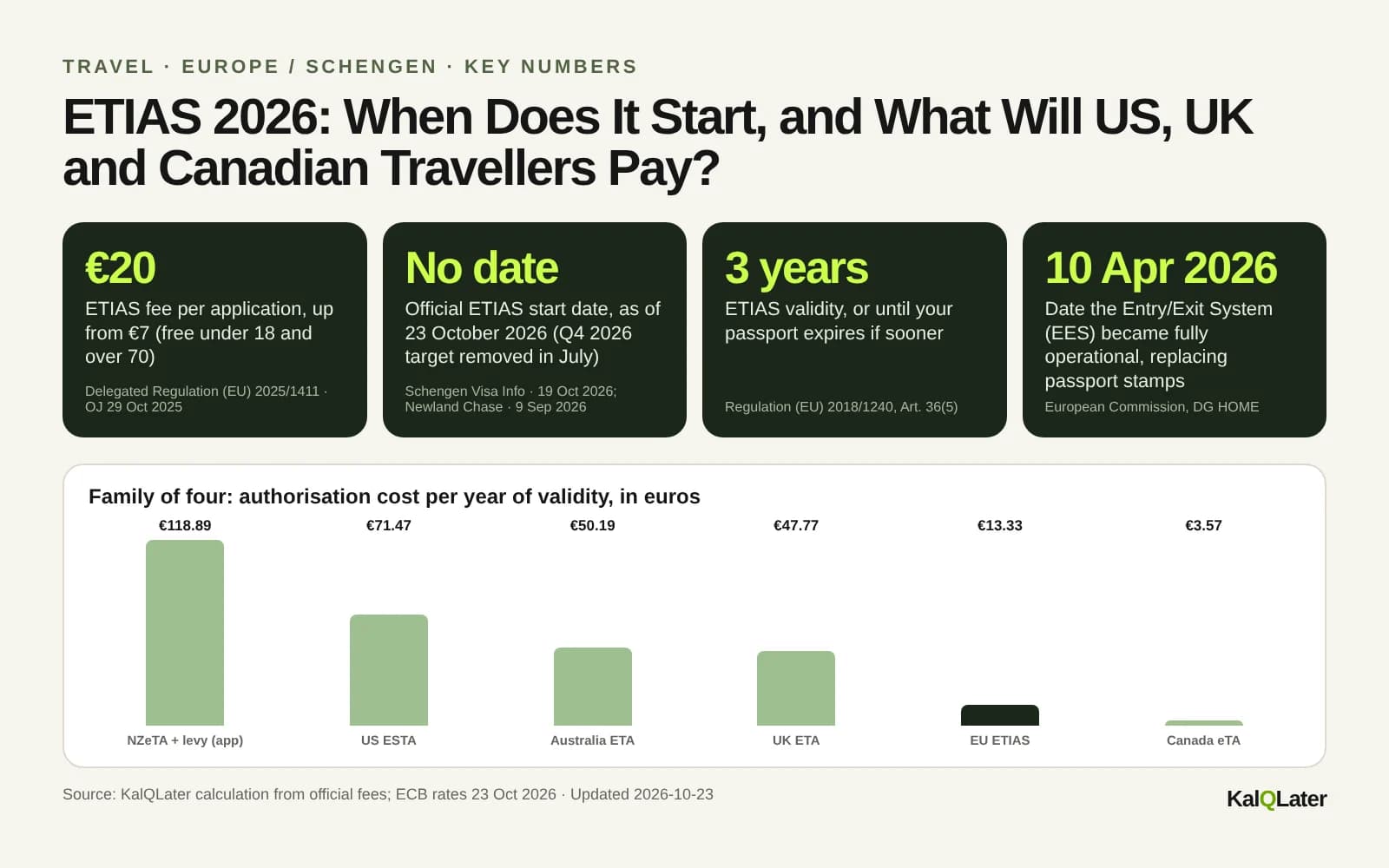
A family of two adults and two children will pay €40 for ETIAS, or €13.33 a year over its three-year validity. The same family would pay $80 a year for US ESTAs, £40 a year for UK ETAs and about €119 a year for New Zealand.
Headline fees hide two big differences: how long the permit lasts, and whether children pay. ETIAS scores well on both. It lasts three years and children are free, so a family of four buys just two paid authorisations. The UK, US, Australia and New Zealand all charge children the same as adults.
Family of four: authorisation cost per year of validity, in euros
Source: KalQLater calculation from official fees; ECB rates 23 Oct 2026View the data
| Label | Value |
|---|---|
| NZeTA + levy (app) | €118.89 |
| US ESTA | €71.47 |
| Australia ETA | €50.19 |
| UK ETA | €47.77 |
| EU ETIAS | €13.33 |
| Canada eTA | €3.57 |
| Scheme | Paid permits | Total (local) | Validity | Per year (local) | Per year (€) | Per year ($) |
|---|---|---|---|---|---|---|
| EU ETIAS | 2 (children free) | €40 | 3 yrs | €13.33 | €13.33 | $14.92 |
| UK ETA | 4 | £80 | 2 yrs | £40.00 | €47.77 | $53.47 |
| US ESTA | 4 | $160 | 2 yrs | $80.00 | €71.47 | $80.00 |
| Canada eTA | 4 | CAD 28 | 5 yrs | CAD 5.60 | €3.57 | $4.00 |
| Australia ETA | 4 | AUD 80 | 1 yr | AUD 80.00 | €50.19 | $56.18 |
| NZeTA + levy (app) | 4 | NZ$468 | 2 yrs | NZ$234.00 | €118.89 | $133.07 |
If grandparents aged 70 or over join the trip, they also pay nothing for ETIAS. A three-generation group of six (two grandparents over 70, two parents, two children) would still pay €40 in total. If a parent’s passport expires after 18 months, they must reapply, so check expiry dates before you buy.
Do US, UK and Canadian citizens need ETIAS? And is it a visa?
Yes: once it launches, US, UK and Canadian citizens will all need an ETIAS to visit 30 European countries, but it is not a visa. It is an online pre-travel check for visa-exempt nationals from 59 countries, covering short stays of up to 90 days in any 180.
Frontex says that when ETIAS starts, visa-free travellers from 59 countries will need a travel authorisation. The US, UK, Canada and Australia are all visa-exempt for the Schengen area, so all four are covered.
ETIAS will apply to 30 countries: the 29 that use the Entry/Exit System plus Cyprus. The EEAS list is Austria, Belgium, Bulgaria, Croatia, Cyprus, Czech Republic, Denmark, Estonia, Finland, France, Germany, Greece, Hungary, Iceland, Italy, Latvia, Liechtenstein, Lithuania, Luxembourg, Malta, Netherlands, Norway, Poland, Portugal, Romania, Slovakia, Slovenia, Spain, Sweden and Switzerland. Ireland is not on it.
- Online form before travel
- €20, free under 18 / over 70
- Valid 3 years, unlimited trips
- Most decisions within minutes
- Not yet operating as of 23 Oct 2026
- Required for non-visa-exempt nationals only
- Consulate application, documents, biometrics
- Not needed by US, UK or Canadian tourists
- Separate system; unchanged by ETIAS
An ETIAS does not guarantee entry. Border guards still decide at the border, and EES will record each entry and exit. Airlines will check it too: Frontex says travellers without a valid authorisation 'will be refused boarding by the carrier'.
How will the ETIAS application work, and why could it be refused?
The application will be an online form on the official EU site, with a decision expected within minutes for about 97% of applicants. The rest go to manual review and can take four days, or up to 30 days if an interview is needed. Refusals are based on security, illegal immigration or epidemic risk.
- 1Wait for the official launch
No applications are being collected as of 23 October 2026. Any site taking ETIAS payments today is not official.
- 2Use only the europa.eu site or official app
You will need a passport that is not due to expire within three months and was issued in the last 10 years.
- 3Fill in personal, passport and background details
Answer the background questions honestly; the answers are screened automatically against EU databases.
- 4Pay €20 (or nothing if under 18 or over 70)
The fee is per application. Children need their own application.
- 5Get a decision by email
Most within minutes. If not, within four days; up to 14 days if extra documents are requested, or 30 days if you are invited to an interview.
- 6Travel with the same passport
ETIAS is linked to the passport you applied with. A new passport means a new ETIAS.
Frontex expects 'about 97%' of applications to be approved automatically within minutes. The remaining 3% are checked by the ETIAS Central Unit, run by Frontex 24 hours a day, and by national units in each member state.
- Lost or stolen passport Using a travel document flagged in the Schengen Information System.
- Security risk Matches against watchlists or security databases.
- Illegal immigration risk For example, previous overstays or refused entries.
- High epidemic risk A ground written into the law for public health emergencies.
- Entry ban An existing SIS alert refusing entry and stay.
- No reply or no-show Not answering a request for more information, or missing a required interview.
These six groups summarise the seven grounds in Article 37(1) of the ETIAS Regulation. A refusal email must give the reasons and explain how to appeal, to which authority, and by when.
What is EES and what happens at the border now?
Since 10 April 2026, every US, UK and Canadian visitor to 29 European countries has their fingerprints and face scanned at the border under the Entry/Exit System. EES replaces passport stamps and costs nothing, but early queues of two to three hours were reported.
The European Commission set 12 October 2025 as the start of a progressive rollout, and says EES 'became fully operational on 10 April 2026'. It records your name, passport details, the date and place of each entry and exit, any refusal of entry, and biometric data: fingerprints and a facial image. From 10 April 2026 it 'replaces the stamping of passports', so overstays are detected automatically.
There is no fee and no application for EES. Your first crossing takes longest because your biometrics are enrolled; later trips should be quicker. The Commission puts the average processing time at 70 seconds per passenger, while airport body ACI Europe says registration can take up to five minutes.
- February 2026 ACI Europe and airlines said waits had reached up to 2 hours at the stage when 35% of non-EU travellers had to be registered, and warned of 4 hours or more in July and August.
- April 2026 In the week of full rollout, queues of up to three hours were reported at airports in France, Germany, Belgium, Italy, Spain and Greece; more than 100 passengers missed an easyJet flight from Milan.
- June 2026 A WTTC survey of 2,500+ travellers from the UK, US, Canada and Australia found about a third would be much less likely to visit, or would not visit, if they regularly faced 3–4 hour waits. WTTC put up to 41 million arrivals and $45.4 billion of spending at risk.
- September 2026 Temporary 'flexibility' rules that let states partly suspend EES at busy times expired on 6 September 2026. Industry groups have asked for them back until at least spring 2027.
US citizen departures to Europe: change vs same month a year earlier
Source: NTTO / US International Trade Administration, monthly total travel volumeView the data
| Label | Value |
|---|---|
| Jun 2025 | 1.4% |
| Aug 2025 | 5.6% |
| Sep 2025 | 4.8% |
| Oct 2025 | 6.8% |
| Mar 2026 | 2.8% |
| Jul 2026 | -1.2% |
The US numbers show demand cooling rather than collapsing. In October 2025, 1,913,716 US citizens flew to Europe, up 6.8%. By July 2026, peak season, departures were 2,754,661, down 1.2% on a year earlier. No official data isolates the EES effect from prices or currency moves.
The 90/180 rule explained, with a worked example
Visa-exempt visitors can stay a maximum of 90 days in any rolling 180-day period across the whole Schengen area. On any day, count back 180 days and add up the days you were inside; the total must not exceed 90. EES now counts those days automatically.
The rule is not '90 days per country' or '90 days per trip'. The Commission’s official guidance says you are 'usually allowed to stay for a maximum of 90 days within any 180-day period', and to check, you 'count back 180 days from each day of your stay'. Days in France, Italy and Spain all add up together. Entry and exit days both count.
Before EES, overstays were spotted by reading passport stamps by hand. Now the system calculates your remaining days from recorded entries and exits. Use the Commission’s short-stay calculator in planning mode to find the latest date you can stay.
ETIAS scams: how to spot a fake ETIAS website
Any website taking ETIAS applications or payments as of 23 October 2026 is not official, because the system is not running. More than 150 sites already offer ETIAS, according to reports this month. The real one will be on a europa.eu address.
On 16 October 2026 reporting by DutchReview noted that 'more than 150 websites already offer ETIAS'. UK travel association ABTA advised travellers not to apply anywhere until the official launch, and Frontex has warned that unofficial sites can overcharge or misuse personal data.
- Check the address Official EU sites end in europa.eu. The ETIAS information site is travel-europe.europa.eu.
- Check the price The official fee will be €20, or €0 for under-18s and over-70s. Anything like €50–€100 includes an agent’s mark-up.
- Check the date If a site is taking money before the EU has announced a launch date, it is not processing a real application.
- Same rule elsewhere Canada tells travellers to apply only on its official Government of Canada website; the same applies to ESTA, the UK ETA and Australia’s ETA app.
What should US, UK and Canadian travellers do now?
For trips booked before an official ETIAS date is announced, you need only a valid passport, plus extra time at the border for EES. Do not pay any website for ETIAS yet. Budget €20 per adult for later trips and check passport expiry dates.
- 1Check your passport
Schengen rules expect at least three months’ validity beyond your planned departure and a passport issued in the last 10 years. A short-dated passport also shortens your future ETIAS.
- 2Allow extra time at the airport
Your first EES crossing includes fingerprint and face enrolment. Early reports showed peak queues of two to three hours.
- 3Count your days
Use the official short-stay calculator if you split long trips across a year. EES will flag an overstay automatically.
- 4Ignore ETIAS sellers
No legitimate application exists yet. Bookmark travel-europe.europa.eu and wait for the launch notice.
- 5Budget for 2027 trips
€20 per adult aged 18–69. A family of four pays €40 for three years of trips.
- 6Watch 17–19 November 2026
The eu-LISA board meeting may produce a revised timeline. We will update this page if a date is announced.
ETIAS claims vs evidence
“You need a visa for Europe now.”
US, UK and Canadian tourists remain visa-exempt. ETIAS is an online authorisation, not a visa, and as of 23 October 2026 it is not operating. EES requires biometrics at the border but no application or fee.
False“ETIAS costs €7.”
€7 was the 2018 figure. Delegated Regulation (EU) 2025/1411, published 29 October 2025, sets the fee at €20 per application.
False“The EU has confirmed ETIAS will launch in Q4 2026.”
The Commission said 'last quarter of 2026' in July 2025, but that window was removed from the official portal in July 2026. No date has been announced as of 23 October 2026.
False“Every member of the family has to pay.”
Article 18(2) waives the fee for applicants under 18 or over 70. Each person still needs their own ETIAS.
False“Europe’s new border system is causing hours-long queues.”
ACI Europe reported waits up to 2 hours in February 2026; queues of up to 3 hours were reported in April. The Commission says average processing is 70 seconds and most states run it well.
Partly true“ETIAS will be valid for three years.”
Article 36(5): three years or until the passport expires, whichever comes first.
Partly trueFrequently asked questions
When does ETIAS start?
As of 23 October 2026 there is no official ETIAS start date. The EU’s earlier target of the last quarter of 2026 was removed from the official portal in July 2026, and most reports now expect 2027. The Commission has said it will announce the date several months in advance, followed by a transition period when ETIAS is optional.
How much does ETIAS cost in 2026?
The ETIAS fee is €20 per application under Delegated Regulation (EU) 2025/1411, up from €7. At ECB rates on 23 October 2026 that is about $22.39, £16.75 or CAD 31.33. Applicants under 18 or over 70 pay nothing. You only pay once ETIAS is operating.
Do US citizens need ETIAS to travel to Europe?
Yes, once it launches. The US is one of 59 visa-exempt countries whose citizens will need an ETIAS for short stays in 30 European countries. Until the EU announces a start date and the transition period ends, Americans need only a valid passport. EES biometric checks already apply at the border.
Do UK citizens need ETIAS after Brexit?
Yes. British passport holders are visa-exempt for the Schengen area and will need an ETIAS once it starts. It will cost €20 and last three years. Ireland is not part of ETIAS, so it is not needed for trips to Ireland.
How long is ETIAS valid for?
An ETIAS is valid for three years or until the passport used in the application expires, whichever comes first. It allows unlimited short trips within the 90-days-in-any-180 rule. If you get a new passport, you need a new ETIAS.
Is ETIAS the same as EES?
No. ETIAS is an online pre-travel authorisation costing €20 that is not yet running. EES is the Entry/Exit System at the border, fully live since 10 April 2026, which records fingerprints, a facial photo and every entry and exit instead of passport stamps. EES has no fee and no application.
How long does ETIAS approval take?
Most applications are expected to be decided within minutes; Frontex expects about 97% to be approved automatically. Otherwise a decision is due within four days, extendable to 14 days if more information is requested or 30 days if you are invited to an interview. Apply well before you travel.
Can I apply for ETIAS now?
No. As of 23 October 2026 the EU is not collecting ETIAS applications, and more than 150 websites offering ETIAS have been reported. Any site taking money now is not official. The real application will be on a europa.eu website or the official app.
How we built this analysis
- Fees were taken from official pages or legal texts where reachable: EUR-Lex (ETIAS €20), GOV.UK (UK ETA £20), canada.ca (eTA CAD 7), MFAT (NZeTA NZ$17/NZ$23 plus NZ$100 levy) and the Australian government (AUD 20). The US ESTA $40 fee is from CBP’s 28 August 2025 Federal Register notice as summarised by BAL and CIBT, because cbp.gov could not be loaded.
- Currency conversions use European Central Bank euro reference rates for 23 October 2026: $1.1193, £0.83728, CAD 1.5665, AUD 1.5939, NZ$1.9682 per €1. Example: UK ETA £20 ÷ 0.83728 = €23.89; × 1.1193 = $26.74.
- Family-of-four cost per year = (fee × number of paying travellers) ÷ validity in years. ETIAS: €20 × 2 adults (children free) ÷ 3 = €13.33. ESTA: $40 × 4 ÷ 2 = $80. UK ETA: £20 × 4 ÷ 2 = £40. eTA: CAD 7 × 4 ÷ 5 = CAD 5.60. Australia: AUD 20 × 4 ÷ 1 = AUD 80. NZ: (NZ$17 + NZ$100) × 4 ÷ 2 = NZ$234. Assumes passports valid for the full period and that children pay the NZ levy (the pages we opened list no age exemption).
- Inflation check: €7 × (1 + 30.12%) = €9.11, using the cumulative inflation figure in recital 2 of Regulation 2025/1411. Fee increase: (€20 − €7) ÷ €7 = 186%.
- 90/180 example: for each day of the planned July stay we counted days inside the Schengen area in the preceding 180 days (that day plus 179 before it); 60 spring days plus 30 July days reaches 90 on 30 July.
- US travel demand uses NTTO monthly 'total international travel volume' releases for June, August, September and October 2025 and March and July 2026, the months we could open. Year-on-year changes are as published by NTTO.
Limitations
The ETIAS launch date, transition length and application details could change; the official ETIAS portal is a JavaScript app we could not load directly, so its current wording is reported via Schengen Visa Info and Newland Chase. The ETIAS processing times and refusal grounds come from the 2018 Regulation and EU guidance written before launch. Queue times are reports from industry groups and media, not official EU statistics, and vary by airport and day. Exchange rates move daily. The NTTO series has gaps and cannot separate the effect of EES from airfares or currency. This article is general information, not legal or immigration advice; check official government sites before you travel.
Spotted an error? See our corrections policy. Read how we work in our methodology and editorial standards.
Sources
- EUR-Lex (European Union)Commission Delegated Regulation (EU) 2025/1411 on the ETIAS travel authorisation fee€20 fee; 30.12% inflation; adopted 16 Jul 2025, OJ 29 Oct 2025
- European Commission, DG Migration and Home AffairsEuropean travel authorisation (ETIAS) will cost EUR 20Fee rationale, age exemptions, Q4 2026 target as of July 2025
- EUR-Lex (European Union)Regulation (EU) 2018/1240 establishing ETIASArticle 18: original €7 fee and under-18/over-70 waiver
- legislation.gov.uk (copy of EU Regulation 2018/1240)ETIAS Regulation, Chapter VI: issue, refusal, annulment or revocationArt. 36(5) 3-year validity; Art. 37(1) refusal grounds
- European External Action ServiceAbout ETIAS30 countries; processing within minutes, 4, 14 or 30 days
- FrontexETIAS59 countries; ~97% automatic approval; carriers refuse boarding
- European Commission, DG Migration and Home AffairsEntry/Exit System (EES)Start 12 Oct 2025; fully operational 10 Apr 2026; biometrics
- GOV.UKApply for an electronic travel authorisation (ETA)£20 fee; children need their own ETA
- Government of Canada (IRCC)Find out about electronic travel authorization (eTA)CAD 7; valid up to 5 years; US citizens exempt
- New Zealand Ministry of Foreign Affairs and TradeInformation on NZeTA and visasNZ$17 app / NZ$23 web; NZ$100 levy; 2 years
- Australian Government (Embassy, Tel Aviv)Electronic Travel Authority: online applicationsAUD 20; validity from Home Affairs ETA (601) listing: 12-month period, stays up to 3 months
- European Central BankEuro foreign exchange reference ratesRates for 23 Oct 2026
- US International Trade Administration (NTTO)July 2026 total international travel volumeUS departures to Europe; other months from NTTO releases for Mar 2026 and Jun–Oct 2025
- ACI EuropeAirports and airlines call for immediate EES review ahead of peak summerWaits up to 2 hours, Feb 2026
- Schengen Visa InfoETIAS has no launch date after years of delaysStatus as of 19 Oct 2026 (news); see also Newland Chase, 9 Sep 2026; BAL/CIBT on ESTA $40; The Local on UK ETA £20 from 8 Apr 2026