Germany’s New EV Subsidy (Up to €6,000): Who Gets It, and Is an Electric Car Worth It Now?
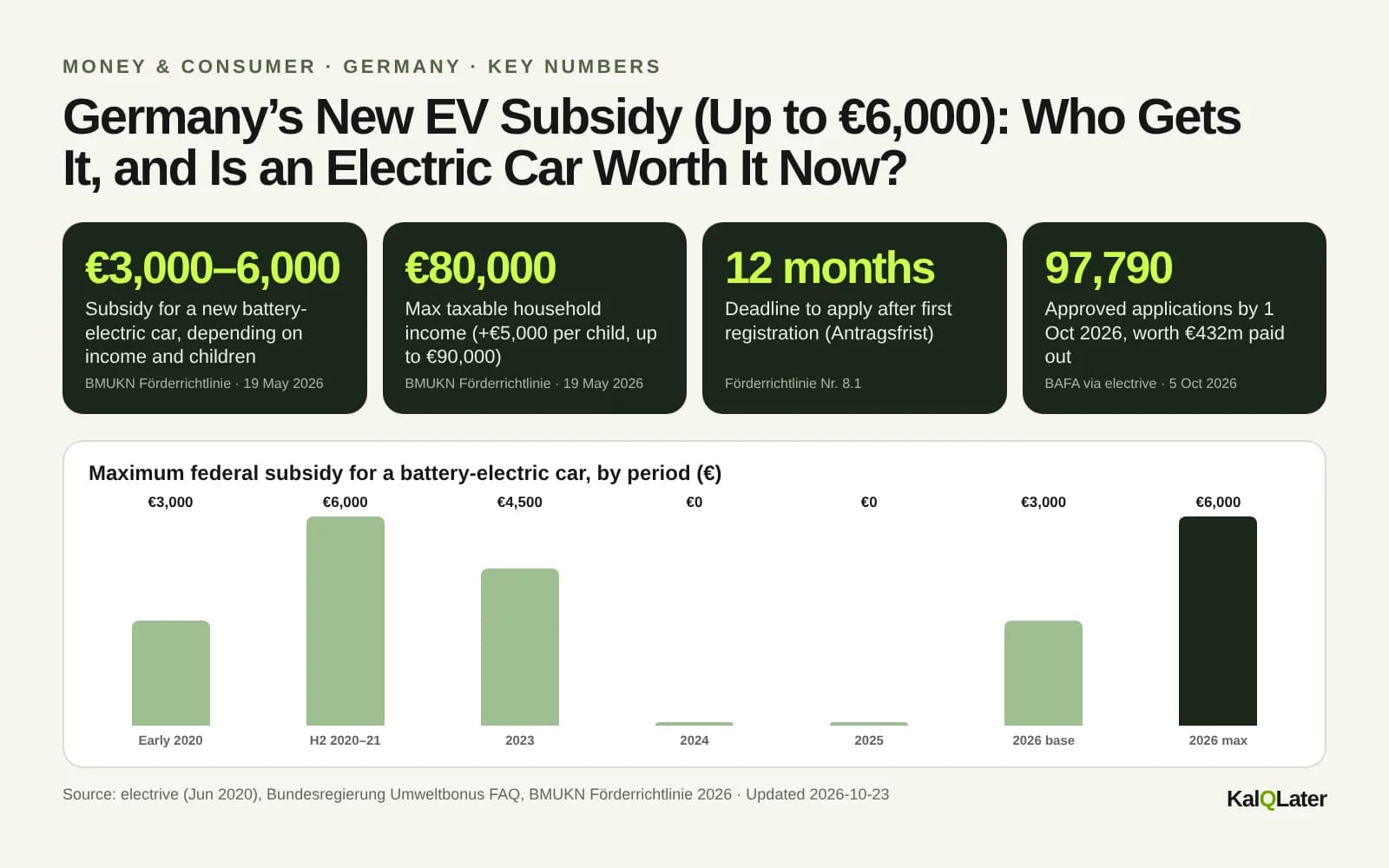
Germany’s E-Auto-Prämie pays €3,000 to €6,000 for a new battery-electric car (€1,500 to €4,500 for a qualifying plug-in hybrid) if your taxable household income is at most €80,000, or up to €90,000 with children. It covers cars first registered since 1 January 2026, but you must apply via BAFA within 12 months of registration and keep the car 36 months. On ADAC cost data, the subsidy turns a slim EV cost advantage into roughly €4,000 to €7,000 over five years.
E-Auto-Prämie 2026: the short answer
The €6,000 headline is real but rare: the base amount is €3,000, and €6,000 needs a household income under €45,000 plus two children. Most approvals so far come from lower-income, childless households, and on our five-year cost example the subsidy is what tips a compact EV from roughly break-even to clearly cheaper than its petrol twin.
Germany restarted its electric car purchase subsidy in 2026 after a two-year gap. The Federal Environment Ministry (BMUKN) sets the rules in a Förderrichtlinie published on 19 May 2026, and the Federal Office for Economic Affairs and Export Control (BAFA) processes the applications through the Förderzentrale Deutschland portal.
Unlike the old Umweltbonus, the new scheme is means-tested. You get a fixed amount based on your taxable household income and the number of children under 18, with a cap of €80,000 income (€90,000 with two children). There is no vehicle price cap, used cars are excluded, and leasing counts.
All figures here are as of 23 October 2026. This is not legal or tax advice; the binding text is the Förderrichtlinie, and BAFA decides each case.
How much is the Elektroauto Förderung 2026? Amounts by income and children
A battery-electric car gets a €3,000 base, plus €1,000 if household income is under €60,000, another €1,000 under €45,000, and €500 per child for up to two children. Plug-in hybrids and range extenders start at €1,500 and use the same bonuses, topping out at €4,500.
Income means zu versteuerndes Einkommen (taxable income, the figure on your tax assessment, not your gross salary). BAFA uses the average of your two most recent Einkommensteuerbescheide, each no older than three calendar years. Partners in the same household (married, registered or cohabiting) have their incomes added together.
| Taxable household income | No children | 1 child | 2+ children |
|---|---|---|---|
| Up to €45,000 | €5,000 (€3,500) | €5,500 (€4,000) | €6,000 (€4,500) |
| €45,001–60,000 | €4,000 (€2,500) | €4,500 (€3,000) | €5,000 (€3,500) |
| €60,001–80,000 | €3,000 (€1,500) | €3,500 (€2,000) | €4,000 (€2,500) |
| €80,001–85,000 | Not eligible | €3,500 (€2,000) | €4,000 (€2,500) |
| €85,001–90,000 | Not eligible | Not eligible | €4,000 (€2,500) |
| Over €90,000 | Not eligible | Not eligible | Not eligible |
BEV figures are from the BMUKN FAQ table. The ministry publishes the PHEV corner values (€3,500 at up to €45,000 with no children; €1,500 at €60,001–80,000 with no children; €4,500 maximum); the other PHEV cells are KalQLater’s application of the same bonuses to the €1,500 base.
Who gets the E-Auto-Prämie, and who is excluded?
Only private individuals aged 18+ with a main residence in Germany qualify, buying or leasing a brand-new car registered in their own name from 1 January 2026. Households above the income limit, companies, business-owned cars and anyone buying a used EV get nothing.
- Higher earners Taxable household income above €80,000 (no children), €85,000 (one child) or €90,000 (two or more children).
- Used cars The car must never have been registered before, in Germany or abroad. The motoring club ACE has criticised the exclusion of used EVs.
- Company and business cars Vehicles in Betriebsvermögen (business assets) are not funded, and you may not move the car into business assets during the holding period.
- People in insolvency Applicants in insolvency proceedings, or who have filed or must file a Vermögensauskunft, are excluded.
- Double funding A car already funded by another public body, or by a comparable scheme in another EU country, does not qualify, unless that funder has an agreement with the BMUKN.
- Internationals Nationality is not a criterion, but you need a German main residence, a German tax assessment (or other accepted income proof) and a BundID login. Newcomers without two German tax assessments should check the Richtlinie before buying.
The limit is one subsidy per applicant and per vehicle, not per household, according to the Richtlinie (Nr. 4). An EU-preference rule limiting the subsidy to European-built cars has been discussed by the government but was not decided as of the latest reports we found.
E-Auto-Prämie Antrag: how to apply step by step
You apply online after the car is registered, through the Förderzentrale Deutschland portal, logging in with a BundID. Upload your last two tax assessments, the purchase or leasing contract and registration document, and Kindergeld proof if you claim the child bonus. BAFA then issues a Zuwendungsbescheid and pays to your account.
- 1Check your income first
Find your last two Einkommensteuerbescheide (no older than three calendar years). Average the zu versteuerndes Einkommen of both years, and add your partner’s if you live together and are not jointly assessed.
- 2Set up a BundID early
You need an online-enabled ID card with its PIN, or an ELSTER certificate. Berliner Zeitung reported waits of several weeks for an ID PIN in Berlin, so do this before you order the car.
- 3Buy or lease a new eligible car
Battery-electric, fuel-cell, or a PHEV/range extender meeting the 60 g/km or 80 km rule. Register it in your own name.
- 4Apply within 12 months of registration
Applications are only possible after first registration and must be submitted no later than 12 months after it (Richtlinie Nr. 8.1). Cars registered since 1 January 2026 can be claimed retroactively.
- 5Upload the documents
Tax assessments as PDF (meinauto.de reports a 5 MB limit and advises redacting sensitive data), the purchase or leasing contract, the Fahrzeugschein and vehicle identification number, Kindergeld proof from the Familienkasse for children, and the CoC document for PHEVs. Some vehicle data is checked automatically with the KBA.
- 6Wait for the Zuwendungsbescheid
BAFA processes complete applications in order of receipt. Payment goes to your bank account after a positive review.
- 7Keep the car 36 months
The car must stay registered to you in Germany for at least 36 months. Report any earlier sale; BAFA may reclaim part or all of the money.
Common mistakes that cost you the E-Auto-Prämie
The most expensive mistakes are missing the 12-month deadline, selling within 36 months, and assuming your gross salary is the income that counts. The retroactive start date means nothing if you never file the Antrag yourself; the dealer does not do it for you.
- Waiting too long “Retroactive” only means cars registered from 1 January 2026 count. Each car still has a 12-month window from its own registration date. A car registered in January 2026 must be claimed by January 2027.
- Using gross salary The test is taxable income from your tax assessment, which is usually well below gross pay after allowances and deductions. Many people who think they earn ‘too much’ may in fact qualify.
- Forgetting your partner’s income A cohabiting partner’s taxable income is added, even if you are not married.
- Counting the wrong children Only children living in the household with a Kindergeld entitlement who were under 18 at the car’s first registration count, and only up to two.
- Buying a pre-registered or used car A Tageszulassung or demo car that was already registered fails the ‘never registered before’ rule.
- Selling or switching to business use early Selling within 36 months, or moving the car into business assets, can trigger repayment.
- Choosing a PHEV late PHEVs registered from 1 July 2027 are not covered under the current rules.
How many people have applied for the E-Auto-Prämie so far?
BAFA had received 103,542 applications by 5 August 2026 and approved 97,790 by 1 October, paying out €432 million, or 14.4% of the €3bn budget. About 52% of approvals went to the lowest income band, and roughly two-thirds to households without a qualifying child.
Demand started fast. BAFA’s president said more than 1,800 applications arrived in the first 15 minutes on 19 May, and meinauto.de counted 19,448 by the afternoon of the following day. The “20,000 applications in the first days” headline is therefore a fair rounding.
| Date | Applications received | Approved | Paid out | Average per approval |
|---|---|---|---|---|
| 20 May 2026 | 19,448 | n/a | n/a | n/a |
| Mid-June 2026 | ≈50,000 | n/a | n/a | n/a |
| 1 Aug 2026 | 103,542 (by 5 Aug) | Just over 28,000 | €117m | €4,350 |
| 1 Sep 2026 | Not published | 52,473 | €230m | €4,380 |
| 1 Oct 2026 | Not published | 97,790 | €432m | €4,418 |
In the approvals to 1 October, 91.6% were battery-electric and 8.4% plug-in hybrids, and purchase and leasing were split roughly 50/50. The most-funded models were the Tesla Model Y (8,297), Skoda Elroq (5,478), Tesla Model 3 (3,845), Citroën ë-C3 (3,583) and Leapmotor T03 (3,561).
Did the subsidy boost electric car sales in Germany?
The BEV share of new cars rose from 22% in January 2026 to a record 34.5% in September, and was 25% in May when the portal opened. That is consistent with a subsidy effect, but the trend was already rising before May, and petrol hit record prices over the summer, so the subsidy is not the only cause.
Battery-electric share of new car registrations in Germany, Jan–Sep 2026
Source: Kraftfahrt-Bundesamt (KBA) monthly figures as reported by electrive, ecomento and elektroauto-newsView the data
| Label | Value |
|---|---|
| Jan | 22.0% |
| Feb | 21.9% |
| Mar | 24.0% |
| Apr | 25.8% |
| May | 25.0% |
| Jun | 28.4% |
| Jul | 29.3% |
| Aug | 32.4% |
| Sep | 34.5% |
The year-on-year jump is large: September 2026 saw 88,599 new battery-electric cars, up about 95% from 45,495 a year earlier, while new petrol-only cars fell 29.2%. July’s share was 29.3% against 18.4% in July 2025. Over January to September, 604,144 BEVs were registered, a 27.2% share and 58.1% more than a year earlier.
Three caveats keep us from crediting the subsidy alone. First, the share was already climbing in March and April, before applications opened, partly because buyers knew registrations from 1 January would count. Second, Super E10 averaged a record €2.266 a litre in September 2026 (ADAC), which pushes buyers toward EVs regardless of subsidies. Third, subsidy approvals (97,790 by 1 October) equal only about 16% of BEV registrations so far this year, although many applications are still pending and fleet cars are not eligible anyway.
From Umweltbonus to E-Auto-Prämie: a short history of German EV subsidies
The Umweltbonus paid about €10 billion for roughly 2.1 million electric vehicles from 2016 until it ended abruptly on 17 December 2023. After that, German BEV sales fell to a 13.5% share in 2024, recovered to 19.1% in 2025 without any subsidy, and are at 27.2% in 2026 so far.
Maximum federal subsidy for a battery-electric car, by period (€)
Source: electrive (Jun 2020), Bundesregierung Umweltbonus FAQ, BMUKN Förderrichtlinie 2026View the data
| Label | Value |
|---|---|
| Early 2020 | €3,000 |
| H2 2020–21 | €6,000 |
| 2023 | €4,500 |
| 2024 | €0 |
| 2025 | €0 |
| 2026 base | €3,000 |
| 2026 max | €6,000 |
The old scheme was not means-tested but capped the car price: in 2023 the federal share was €4,500 up to €40,000 net list price and €3,000 up to €65,000. Plug-in hybrids were dropped in 2023, and commercial buyers were cut off from 1 September 2023. Of about 2.2 million funded vehicles (electrive’s count), over 1.4 million were BEVs and nearly 800,000 PHEVs.
The end came suddenly. After the Federal Constitutional Court voided the transfer of unused Covid credit into the climate fund, applications closed at the end of 17 December 2023. The new scheme draws on the same Klima- und Transformationsfonds, which is one reason to apply promptly.
BEV share of new cars in Germany by year
Source: KBA via electrive (Jan 2026) and ecomento (Oct 2026)View the data
| Label | Value |
|---|---|
| 2023 | 18.4% |
| 2024 | 13.5% |
| 2025 | 19.1% |
| 2026 (Jan–Sep) | 27.2% |
Is an electric car worth it now? Five-year cost, EV vs petrol, with and without the subsidy
On ADAC’s April 2026 cost data, an Opel Astra Electric costs about €45,150 over five years and 75,000 km, versus €46,425 for the petrol Astra, a €1,275 gap. With the €3,000 base subsidy the EV is about €4,275 cheaper; with €6,000, about €7,275. Charging only at public stations erases the advantage without a subsidy.
We picked the Opel Astra, one of the few compact cars ADAC compares as an electric and a petrol version of the same model. ADAC’s total cost of ownership (purchase-based depreciation, energy, insurance, tax, servicing) assumes 15,000 km a year for five years, petrol at €1.92 a litre and home charging at 35 ct/kWh. ADAC explicitly left the E-Auto-Prämie out. We multiplied its cost per km by 75,000 km and subtracted the subsidy.
| Scenario | Cost per km | 5-year total | vs petrol (€1.92/l) |
|---|---|---|---|
| Petrol Astra, E10 at €1.92/l (ADAC) | 61.9 ct | €46,425 | – |
| Petrol Astra, E10 at Sep 2026 average €2.266/l | ≈63.5 ct | ≈€47,645 | +€1,220 |
| Astra Electric, no subsidy, 35 ct/kWh | 60.2 ct | €45,150 | −€1,275 |
| Astra Electric + €3,000 base subsidy | 56.2 ct | €42,150 | −€4,275 |
| Astra Electric + €5,000 (income ≤ €45,000) | 53.5 ct | €40,150 | −€6,275 |
| Astra Electric + €6,000 (max) | 52.2 ct | €39,150 | −€7,275 |
| Astra Electric, own solar 18 ct/kWh, no subsidy | 57.7 ct | €43,275 | −€3,150 |
| Astra Electric, public charging only 60 ct/kWh, no subsidy | 64.0 ct | €48,000 | +€1,575 |
| Astra Electric, public only 60 ct/kWh + €3,000 | 60.0 ct | €45,000 | −€1,425 |
Five-year cost of a compact car in Germany, KalQLater scenarios (€)
Source: KalQLater calculation from ADAC Kostenvergleich (Apr 2026), ADAC Autokatalog and ADAC fuel pricesView the data
| Label | Value |
|---|---|
| Petrol, fuel at Sep 2026 price | €47,645 |
| Petrol, ADAC base (€1.92/l) | €46,425 |
| EV, public charging only | €48,000 |
| EV, no subsidy | €45,150 |
| EV + €3,000 | €42,150 |
| EV + €6,000 | €39,150 |
Two cautions. The subsidy closes most of the up-front gap (ADAC lists the Astra Electric at €37,990 and the petrol hybrid at €32,990, a €5,000 difference), but we assume you keep the full subsidy; if dealers trim discounts or resale values fall because new EVs are subsidised, the real gain is smaller. And household power averaged 37.0 ct/kWh in 2026 according to BDEW, slightly above ADAC’s 35 ct assumption, which would add a few hundred euros over five years.
Who benefits most from the Elektroauto Förderung, and who should wait?
The scheme pays most to lower-income families who can charge at home, and least to higher earners and people without a driveway. If your taxable household income is under €45,000 and you charge at 35 ct/kWh or less, our example puts a new compact EV €6,000 to €7,000 ahead of petrol over five years.
- Taxable household income under €60,000 (€4,000+ subsidy)
- Home charging or solar panels
- 15,000 km a year or more
- You will keep the car at least 3 years anyway
- You already have two German tax assessments and a BundID
- Income above the limit: no subsidy, EV roughly break-even on ADAC data
- Relying only on public chargers at 60 ct/kWh
- Planning to sell within 36 months
- Want a used EV (not covered)
- Considering a PHEV after June 2027
For readers who moved to Germany recently, the paperwork is the bottleneck: without German tax assessments you may struggle to prove income, and the BundID needs a German eID or ELSTER certificate. For high-mileage drivers worried about battery wear, see our analysis of whether high-mileage EVs are really reliable.
What should you do if you want the E-Auto-Prämie?
Check your taxable income on your last two tax assessments, set up a BundID, and file the Antrag as soon as the car is registered rather than near the 12-month deadline. Funds are paid first-come, first-served and can stop when the budget runs out.
- Do the income test before you shop Average the zu versteuerndes Einkommen from your last two Bescheide and add your partner’s. Compare it with the table above.
- Price the car after subsidy Compare the net price with a petrol equivalent, and get real insurance and tariff quotes. Do not assume the €6,000 maximum.
- Avoid pre-registered stock Make sure the car has never been registered, and that it is registered to you, not a company.
- File within days, not months The deadline is 12 months, but processing is in order of complete applications and the budget is finite.
- Diary the 36-month date Note the date three years after registration before you consider selling or moving abroad.
E-Auto-Prämie headlines vs evidence
““Up to €6,000 subsidy for e-cars” (Berliner Zeitung)”
True as a maximum, but only for a BEV, household income up to €45,000 and two children. The base is €3,000; PHEVs top out at €4,500. The average approval is €4,418.
Partly true““20,000 applications in the first days” (meinauto.de)”
meinauto.de counted 19,448 by the afternoon after launch; BAFA had 103,542 by 5 August.
True““E-Auto-Prämie retroactive, but no money without this decisive step” (leinetal24)”
Cars registered since 1 Jan 2026 qualify, but you must apply yourself within 12 months of registration and keep the car 36 months.
True“The subsidy caused the EV sales boom”
BEV share rose to 34.5% in September, but it was rising before the portal opened and petrol hit record prices in September. Effect likely, size unproven.
Too early“An electric car is always cheaper than petrol now”
On ADAC data the compact EV is €1,275 cheaper over five years without subsidy at 35 ct/kWh, but €1,575 dearer if charged only at 60 ct/kWh public chargers.
Misleading“The €3bn will fund 800,000 cars”
Ministry estimate. At the €4,418 average paid so far, €3bn funds about 679,000 cars.
Partly trueFrequently asked questions
How much is the E-Auto-Prämie 2026?
A new battery-electric car gets €3,000 to €6,000: a €3,000 base, plus €1,000 if taxable household income is under €60,000, another €1,000 under €45,000, and €500 per child for up to two children. Qualifying plug-in hybrids and range extenders get €1,500 to €4,500.
What is the income limit for the Elektroauto Förderung?
Taxable household income (zu versteuerndes Einkommen) of up to €80,000 a year, plus €5,000 per child under 18, capped at €90,000 for two or more children. BAFA averages your two most recent tax assessments, and adds a cohabiting partner’s income.
Is the E-Auto-Prämie retroactive?
Yes. Cars first registered on or after 1 January 2026 qualify, even though the portal only opened on 19 May 2026. But each application must be filed no later than 12 months after that car’s registration, so a January 2026 car must be claimed by January 2027.
How do I submit the E-Auto-Prämie Antrag?
Online via the Förderzentrale Deutschland portal, run by BAFA, after the car is registered. You log in with a BundID (eID card with PIN or ELSTER certificate) and upload your last two tax assessments, purchase or leasing contract, registration document, Kindergeld proof for children and, for PHEVs, the CoC document.
Does the subsidy apply to leasing and used electric cars?
Leasing a new car qualifies, and BAFA data show roughly half of approvals are leases. Used EVs do not qualify: the car must never have been registered before in Germany or abroad. Company cars and vehicles in business assets are also excluded.
Do I have to repay the E-Auto-Prämie if I sell the car?
Possibly. The car must stay registered to you in Germany for at least 36 months. If you sell earlier, you must report it, and BAFA decides whether to reclaim part or all of the subsidy. A rescinded purchase or lease means full repayment plus interest, with a limited replacement exception.
Is an electric car cheaper than petrol in Germany in 2026?
Usually, if you charge at home. On ADAC’s April 2026 data, an Opel Astra Electric costs about €45,150 over five years and 75,000 km versus €46,425 for the petrol version. With the €3,000 base subsidy the EV saves about €4,275, but public-only charging at 60 ct/kWh erases the unsubsidised advantage.
How long will the E-Auto-Förderung money last?
The budget is €3 billion for registrations from 2026 to 2029, and the Richtlinie runs to 31 December 2029. By 1 October 2026, €432 million had been paid. There is no legal entitlement, and a funding stop can be declared once the money is gone, as happened to the Umweltbonus in December 2023.
How we built this analysis
- Eligibility, amounts, deadlines and holding period come from the BMUKN Förderrichtlinie of 19 May 2026 and the BMUKN FAQ. PHEV amounts other than the published corner values apply the same income and child bonuses to the €1,500 base.
- Average subsidy per approval = funds paid ÷ approvals (BAFA via electrive): €432m ÷ 97,790 = €4,418 at 1 Oct 2026. Implied number of cars = €3bn ÷ €4,418 ≈ 679,000; break-even average for 800,000 cars = €3bn ÷ 800,000 = €3,750.
- Five-year cost = ADAC cost per km (Kostenvergleich, Apr 2026: 15,000 km/year, 5 years, petrol €1.92/l, electricity 18/35/45/60 ct/kWh) × 75,000 km, minus the subsidy for subsidised scenarios. Example: 60.2 ct × 75,000 = €45,150; minus €3,000 = €42,150; vs petrol 61.9 ct × 75,000 = €46,425.
- Fuel-price sensitivity: WLTP 4.7 l/100 km (ADAC Autokatalog) × 75,000 km = 3,525 litres; × (€2.266 − €1.92) = €1,220 extra over five years.
- Budget burn: payouts rose from €230m (1 Sep) to €432m (1 Oct), about €202m a month; remaining €2.568bn ÷ €202m ≈ 12.7 months. Simple extrapolation, not a forecast.
- BEV shares are KBA monthly figures as reported by electrive, ecomento and elektroauto-news; approvals as a share of BEV registrations = 97,790 ÷ 604,144 ≈ 16%.
Limitations
BEV registration data cannot isolate the subsidy’s effect from fuel prices, new models and buyers who delayed purchases until the portal opened. BAFA has not published total applications since early August, and approvals lag applications, so approval counts understate demand. The cost example uses ADAC list-price-based assumptions for one model pair; your insurance, tariff, discounts, mileage and resale value will differ, and real-world fuel and electricity use differs from WLTP. Rules can change: the PHEV rules after 30 June 2027 and a possible EU-preference rule were undecided as of 23 October 2026. This is not legal, tax or financial advice; the Förderrichtlinie and BAFA’s decision are binding.
Spotted an error? See our corrections policy. Read how we work in our methodology and editorial standards.
Sources
- Bundesministerium für Umwelt, Klimaschutz, Naturschutz und nukleare Sicherheit (BMUKN)Förderrichtlinie E-Auto-Förderung (19 May 2026)Eligibility, 12-month deadline, 36-month holding period, exclusions, end date
- BMUKNFragen und Antworten zur E-Auto-FörderungAmount table by income and children, PHEV rules, budget
- BMUKN / BAFAPressemitteilung 057/26: E-Auto-Förderung kann ab jetzt beantragt werden (19 May 2026)Portal launch, documents, Jan–Apr 2026 BEV share 23.6%
- BundesregierungUmweltbonus läuft aus (FAQ)End on 17 Dec 2023, 2023 rates, €10bn for 2.1m vehicles
- electrive (BAFA data)E-Auto-Förderung: 100.000 Haushalte mit bewilligten Anträgen (5 Oct 2026)Approvals, payouts, income bands, top models
- meinauto.de (BAFA data)E-Auto-Förderung: mehr als 100.000 Anträge (6 Aug 2026)103,542 applications by 5 Aug 2026
- meinauto.deE-Auto-Prämie gefragt: bereits 20.000 Anträge in den ersten Tagen (22 May 2026)19,448 applications after launch
- electrive (KBA data)Neuer Spitzenwert: Mehr als jeder dritte Neuwagen ist ein Elektroauto (Oct 2026)September 2026 registrations and BEV share
- ecomento (KBA data)Pkw-Neuzulassungen in den ersten 9 Monaten 2026Jan–Sep 2026 BEV total and share
- electrive (KBA data)Bilanz 2025: Elektroauto-Neuzulassungen auf Rekordhoch (6 Jan 2026)Annual BEV shares 2023–2025
- electrive (KBA data)KBA: Fast 30 Prozent der Neuwagen sind elektrisch (Jul 2026) and Mai-Bilanz (May 2026)Monthly BEV shares Mar–Jul 2026; also electrive 3 Mar 2026 (Jan–Feb) and 3 Jun 2026 (May)
- ADACElektroauto-Kostenvergleich (Stand April 2026)Cost per km, Opel Astra Electric vs petrol, assumptions
- ADAC AutokatalogOpel Astra 1.2 DI Turbo Hybrid 48V Edition eDCT (ab 03/26)WLTP 4.7 l/100 km
- BDEWBDEW-Strompreisanalyse (Aug 2026)Average household electricity price 37.0 ct/kWh in 2026
- ms-aktuell (ADAC fuel data)Spritpreise bleiben hoch trotz Tankrabatt (9 Oct 2026)E10 September 2026 average €2.266/l, 7 Oct €2.126/l, fuel tax cut