Germany Minimum Wage 2027: €14.60 an Hour, but What’s Left After Tax?
Germany’s minimum wage rises to €14.60 per hour on 1 January 2027, which is €2,530.67 gross a month for a 40-hour week and roughly €1,783 net for a single, childless employee in tax class I (KalQLater estimate). That is about 70% of gross. The Minijob limit rises from €603 to €633 a month, so a minimum-wage Minijobber can work about 43 hours a month.

Mindestlohn 2027: the short answer
The €14.60 headline is real and already set: it applies from 1 January 2027. But a full-time worker keeps only about half of the extra €121 gross a month after tax and contributions, by our estimate, because social contribution rates are flat-to-rising and income tax bites harder as pay climbs.
The rise from €13.90 to €14.60 is the second of two steps proposed by the independent Mindestlohnkommission in June 2025. The federal government adopted it by regulation (Verordnung), and the Bundesregierung confirms that the minimum wage will reach €14.60 in 2027, a total increase of 13.88% over the two steps from €12.82.
For someone on a 40-hour week, the 2027 step adds €121.33 gross a month (0.70 × 40 × 52 ÷ 12). Our worked example puts the net gain at about €65 a month, comparing 2026 and 2027 with the same income tax formula. That gap is the core of the trend-vs-reality story: headlines quote the gross figure, payslips show the net one.
The numbers in this article are as of 23 October 2026. Some 2027 inputs are still drafts: the official average health insurance Zusatzbeitrag (due by 1 November 2026), the 2027 income tax schedule, and the care insurance reform. We label each one.
Mindestlohn 2027 brutto netto calculator
Enter an hourly wage and weekly hours to estimate gross and net monthly pay in Germany with 2027 social contribution rates. It also checks whether the job stays under the €633 Minijob limit or falls into the Midijob range. Results are estimates, not a payslip.
- Gross monthly / annual
- 2.530,67 € / 30.368,00 €
- Pension insurance (9.3%)
- 235,35 €
- Unemployment insurance (1.3%)
- 32,90 €
- Health insurance (7.3% + 1.45%)
- 221,43 €
- Care insurance (2.7%)
- 68,33 €
- Social contributions
- 558,01 €
- Income tax a month (estimate, 2026 formula)
- 189,67 €
- Net monthly (estimate)
- 1.782,99 € · 70.5% of gross
- Minijob limit €633
- above · Minijob hours at this wage: 43.4 h/month
Estimate, not a payslip. 2027 contribution rates as planned; the average Zusatzbeitrag (2.9%) is an estimate until the health ministry sets it by 1 November 2026, and the 0.9-point childless care surcharge is still a bill. Uses the 2026 income-tax formula; no solidarity surcharge or church tax (church tax adds 8–9% of income tax).
What changes on 1 January 2027?
Three numbers change together on 1 January 2027: the minimum wage (€13.90 to €14.60), the Minijob limit (€603 to €633) and the lower edge of the Midijob range (from €603.01 to €633.01). The Midijob upper limit stays at €2,000 a month.
| Item | 2026 | 2027 | Change |
|---|---|---|---|
| Mindestlohn (gross per hour) | €13.90 | €14.60 | +€0.70 (+5.04%) |
| Full-time gross per month (40 h/week) | €2,409.33 | €2,530.67 | +€121.33 |
| Minijob-Grenze (per month) | €603 | €633 | +€30 |
| Minijob limit (per year) | €7,236 | €7,596 | +€360 |
| Midijob / Übergangsbereich | €603.01 to €2,000 | €633.01 to €2,000 | Lower edge moves up |
The Minijob limit is not set separately. It is tied to the minimum wage by a formula: Mindestlohn × 130 ÷ 3, rounded up. For 2027 that is 14.60 × 130 ÷ 3 = 632.67, rounded to €633. The formula assumes 10 hours a week at the minimum wage.
Other 2027 changes reported this month by the Stuttgarter Zeitung (15 October 2026) include a planned Kindergeld rise from €259 to €267 per child and a projected pension increase of about 4.4% from July 2027. Both are plans or projections, not law yet.
How has the German minimum wage grown since 2015?
The German minimum wage has risen from €8.50 in 2015 to €14.60 in 2027, an increase of 71.8% in 12 years. The biggest single jump was to €12.00 in October 2022 (+14.8%); the 2026 step added 8.42%.
German statutory minimum wage, € per hour, 2015–2027
Source: TK minimum wage history; BundesregierungView the data
| Label | Value |
|---|---|
| 2015 | €8.50 |
| 2017 | €8.84 |
| 2019 | €9.19 |
| 2020 | €9.35 |
| Jan 2021 | €9.50 |
| Jul 2021 | €9.60 |
| Jan 2022 | €9.82 |
| Jul 2022 | €10.45 |
| Oct 2022 | €12.00 |
| 2024 | €12.41 |
| 2025 | €12.82 |
| 2026 | €13.90 |
| 2027 | €14.60 |
Prices also rose over this period, so the real increase is smaller than 71.8%. We do not adjust for inflation here; the chart shows nominal euros.
The commission’s June 2025 decision covered two years at once, which is why the 2027 figure has been known for more than a year.
Mindestlohn 2027 brutto netto: what do you actually take home?
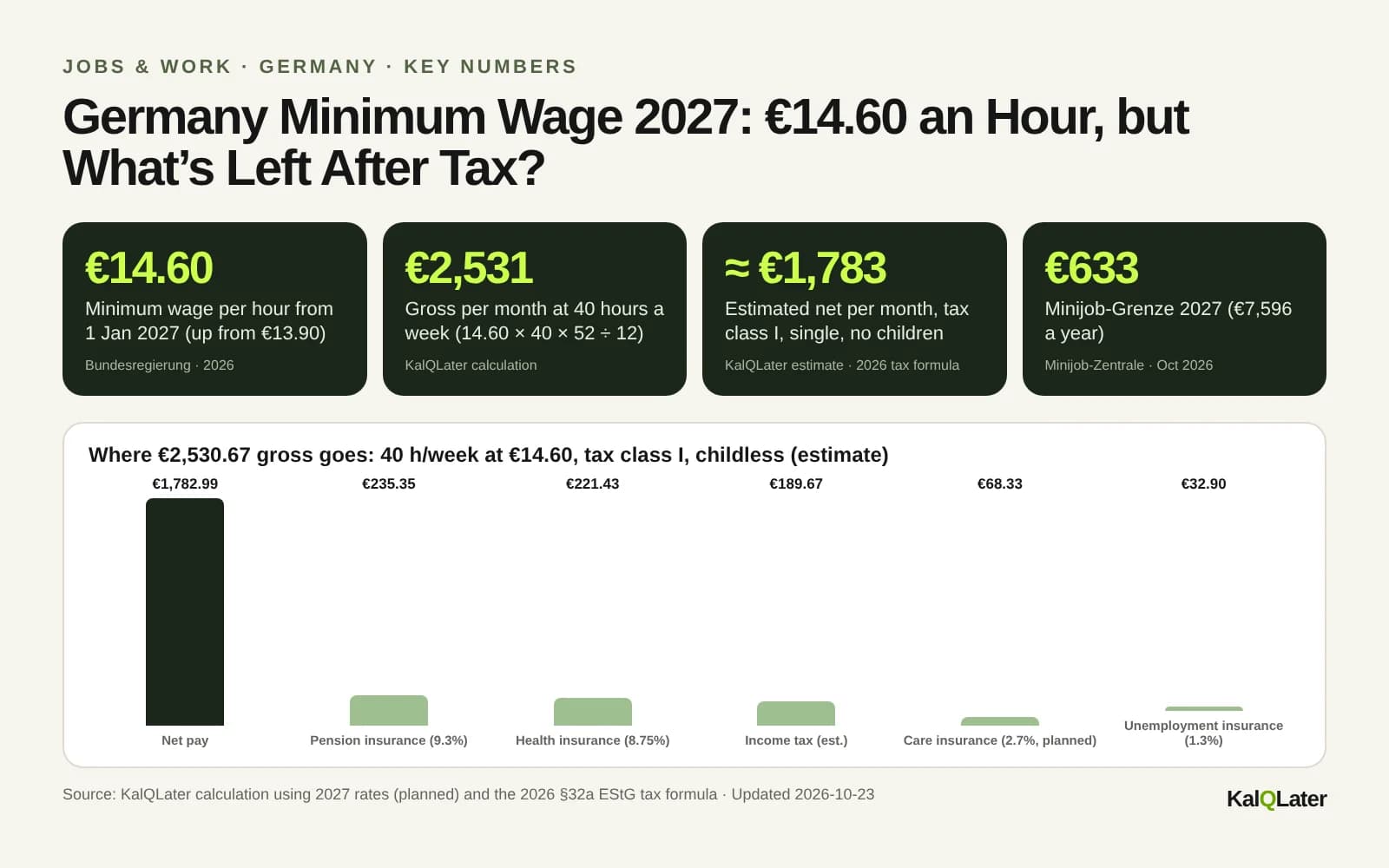
At €14.60 and 40 hours a week, a single, childless employee in tax class I takes home roughly €1,783 a month out of €2,530.67 gross, by our estimate. Social contributions take about €558 and income tax about €190. Parents pay slightly less care insurance.
Where €2,530.67 gross goes: 40 h/week at €14.60, tax class I, childless (estimate)
Source: KalQLater calculation using 2027 rates (planned) and the 2026 §32a EStG tax formulaView the data
| Label | Value |
|---|---|
| Net pay | €1,782.99 |
| Pension insurance (9.3%) | €235.35 |
| Health insurance (8.75%) | €221.43 |
| Income tax (est.) | €189.67 |
| Care insurance (2.7%, planned) | €68.33 |
| Unemployment insurance (1.3%) | €32.90 |
| Case | Gross/month | Social contributions | Income tax (est.) | Net/month (est.) |
|---|---|---|---|---|
| 40 h/week, childless | €2,530.67 | €558.01 | €189.67 | ≈ €1,783 |
| 40 h/week, one child (care 1.8%) | €2,530.67 | €535.24 | €195.58 | ≈ €1,800 |
| 38.5 h/week, childless | €2,435.77 | €537.09 | €170.50 | ≈ €1,728 |
| 35 h/week, childless | €2,214.33 | €488.26 | €126.58 | ≈ €1,599 |
| Comparison: 40 h/week at €13.90 (2026 rates) | €2,409.33 | €524.03 | €167.00 | ≈ €1,718 |
Why does the parent pay more tax in the table? Lower care contributions mean slightly higher taxable income. The net result is still about €17 a month better for the parent. Child benefits (Kindergeld) are paid separately and are not included.
Tax class III (married, partner with little or no income) would roughly double the tax-free part of income and cut the tax line sharply, but the household is assessed jointly at year end. Our calculator gives a simple tax class III approximation.
Which social contribution rates apply in 2027?
An employee in Germany pays about 21–22% of gross pay in social contributions in 2027: 9.3% pension, 1.3% unemployment, 7.3% health plus half the Zusatzbeitrag, and 1.8% care (2.7% if childless, planned). Most 2027 values are planned or estimated as of 23 October 2026.
| Insurance | Total rate | Employee share | Status |
|---|---|---|---|
| Pension (Rentenversicherung) | 18.6% | 9.3% | Planned, unchanged |
| Unemployment (Arbeitslosenversicherung) | 2.6% | 1.3% | Planned, unchanged |
| Health, general rate (Krankenversicherung) | 14.6% | 7.3% | Fixed by law |
| Health, average Zusatzbeitrag | 2.9% (estimate) | 1.45% | Schätzerkreis estimate 14 Oct 2026; BMG sets it by 1 Nov 2026 |
| Care (Pflegeversicherung), parents | 3.6% | 1.8% | Planned, unchanged |
| Care, childless surcharge | +0.9 points (from 0.6) | 2.7% in total | Government bill, cabinet 30 Sep 2026; not yet passed |
The average Zusatzbeitrag is a benchmark. Your own health insurer (Krankenkasse) sets its actual rate, and the rate actually charged in 2026 averaged about 3.13%, above the 2.9% benchmark. Each 0.1 point of Zusatzbeitrag costs a full-time minimum-wage worker about €1.27 a month.
Minijob-Grenze 2027: how many hours can you work for €633?
At the 2027 minimum wage, a Minijobber can work about 43.4 hours a month (633 ÷ 14.60) before hitting the €633 limit. If you earn more per hour, the allowed hours fall. Above €633 the job becomes a Midijob, with reduced employee contributions up to €2,000 a month.
- Minijob (up to €633 a month) No income tax or social contributions for the employee, except a 3.6% pension contribution unless you apply for an exemption. At €633 that is €22.79, leaving €610.21; exempt, you keep €633. The employer pays flat rates (currently 13% health, 15% pension, 2% flat tax plus levies).
- Occasional overshoot An unforeseeable excess is allowed in at most two calendar months within 12 months, up to €1,266 in a month (double the limit), according to the Minijob-Zentrale.
- Midijob (€633.01 to €2,000) Employee contributions start low and rise to the full rate at €2,000 (the Übergangsbereich). At €14.60 an hour, €2,000 a month equals about 31.6 hours a week, so many part-timers fall in this range. The 2027 formula factor F is planned at 0.7683.
- Paid above the minimum? The limit is designed around 10 hours a week at exactly the minimum wage. If you earn more per hour, or your employer raises your rate in January while your hours stay the same, check that your monthly pay still stays at or below €633.
How does Germany’s minimum wage compare with the rest of the EU?
In January 2026 Germany’s monthly minimum wage was €2,343, the third highest of 22 EU countries behind Luxembourg (€2,704) and Ireland (€2,391). Adjusted for price levels, Germany ranked first: PPS 2,157, according to Eurostat.
Monthly minimum wage in the EU, January 2026 (€ gross)
Source: Eurostat, minimum wages 1 January 2026 (published 30 Jan 2026)View the data
| Label | Value |
|---|---|
| Luxembourg | €2,704 |
| Ireland | €2,391 |
| Germany | €2,343 |
| Netherlands | €2,295 |
| Belgium | €2,112 |
| France | €1,823 |
| Spain* | €1,381 |
| Slovenia* | €1,278 |
| Lithuania | €1,153 |
| Poland | €1,139 |
| Cyprus | €1,088 |
| Portugal | €1,073 |
| Croatia | €1,050 |
| Greece | €1,027 |
| Malta | €994 |
| Czechia | €924 |
| Slovakia | €915 |
| Estonia | €886 |
| Hungary | €838 |
| Romania | €795 |
| Latvia | €780 |
| Bulgaria | €620 |
The nominal gap between the highest and lowest EU minimum wage was 4.4 times. Measured in purchasing power standards (PPS), which adjust for price levels, the gap shrinks to 2.4 times, and Germany moves to the top because its prices are lower than Luxembourg’s or Ireland’s.
For expats comparing offers, gross pay alone misleads. In Germany, employee social contributions take about 22% of gross pay before any income tax. For a very different system with no income tax, see our Dubai salary calculator.
How many workers get the 2027 minimum wage rise?
Destatis estimated in July 2025 that up to 8.3 million jobs (about 21%) paid less than €14.60 an hour in April 2024. That is an upper bound. Newer data suggest far fewer: only up to 4.8 million jobs were actually affected by the January 2026 step.
The 8.3 million figure is widely repeated, but it uses April 2024 wages and ignores pay rises since then, so Destatis itself calls it an overestimate. When it re-ran the 2026 step with April 2025 data, the affected count fell from up to 6.6 million to up to 4.8 million jobs (about 12%).
Jobs paid at or below the minimum wage, Germany (thousands)
Source: Destatis, jobs in the minimum-wage range (as of 6 March 2026)View the data
| Label | Value |
|---|---|
| Apr 2015 | 1,907k |
| Apr 2016 | 1,754k |
| Apr 2017 | 1,371k |
| Apr 2018 | 926k |
| Apr 2019 | 1,421k |
| Apr 2022 | 703k |
| Oct 2022 | 2,539k |
| Apr 2023 | 2,409k |
| Apr 2024 | 1,437k |
| Apr 2025 | 1,525k |
- Women and East Germany In the 2026 re-run, about 14% of women’s jobs were affected versus 11% of men’s, and 14% in the east versus 12% in the west.
- Hospitality and farming In the July 2025 estimate for €13.90, 56% of hospitality jobs and 43% of agriculture, forestry and fishing jobs were below the new rate.
- Mostly Minijobs Two in three jobs at the minimum wage in April 2025 were Minijobs, which is why the Minijob-Grenze matters so much.
Who is not entitled to the Mindestlohn?
Under §22 of the Mindestlohngesetz, the minimum wage does not apply to under-18s without completed vocational training, apprentices, volunteers, long-term unemployed people in their first six months of a new job, and certain internships. Everyone else, including foreign workers and Minijobbers, must get at least €14.60.
- Minors without vocational training Young people covered by the youth employment protection law (JArbSchG) who have not completed vocational training.
- Apprentices (Auszubildende) Their pay is governed by vocational training law, not the minimum wage.
- Long-term unemployed For people who were long-term unemployed immediately before starting, the minimum wage does not apply in the first six months of the job.
- Mandatory internships Internships required by school, university or training rules are exempt.
- Short voluntary internships Orientation internships and internships alongside study or training are exempt for up to three months.
- Volunteers (Ehrenamtliche) Honorary work is not covered.
What should employees and employers do before January 2027?
Employees should check their January 2027 payslip shows at least €14.60 per hour, and Minijobbers should confirm their hours still fit under €633. Employers should update payroll, review Minijob hours and adjust any contracts with a fixed monthly salary close to the minimum.
- 1Check your hourly rate
Divide your monthly gross by your paid hours. Full-time at 40 hours a week must be at least €2,530.67 gross from January 2027.
- 2Minijobbers: count your hours
At €14.60, the €633 limit allows about 43 hours a month. If your hourly rate is higher, you can work fewer hours.
- 3Check your Krankenkasse rate
Insurers announce 2027 Zusatzbeiträge around the turn of the year. A higher rate cuts net pay; you can switch insurer if yours rises.
- 4Employers: update payroll and contracts
Raise base rates, review fixed-salary contracts and check Minijob hours against the new €633 limit.
- 5Watch for the final 2027 tax and care rules
The 2027 tax schedule and the childless care surcharge are still in parliament. We will update this page when they pass.
If you are comparing job options in Germany, our report on remote jobs in 2026 looks at how competitive remote roles are.
Minimum wage vs Grundsicherung: does work still pay?
Yes, by a wide margin for full-time work: about €1,783 net versus a €563 standard rate in the new Grundsicherung. The basic income support that replaced Bürgergeld from July 2026 kept the single-adult standard rate at €563 in 2026; the 2027 rate is still open.
The comparison is not one-to-one. Grundsicherung recipients also get housing and heating costs paid on top of the €563, so the full support package is worth more than the standard rate alone. Even so, the gap between full-time minimum-wage net pay and the standard rate is about €1,220 a month on our estimate.
The BMAS describes the new system as the Grundsicherung für Arbeitsuchende with the Grundsicherungsgeld, in force from July 2026, with the standard rate unchanged in 2026. The 2027 figure must still be published.
Claims vs evidence: Mindestlohn 2027
“The minimum wage rises to €14.60 in 2027.”
Confirmed by the Bundesregierung; applies from 1 January 2027 after the June 2025 commission proposal was adopted by regulation.
True“Full-time workers get €121 more a month.”
True gross (0.70 × 173.33 hours). Our estimate of the net gain for a single, childless worker is about €65 a month.
Misleading“The Minijob limit rises to €633.”
Minijob-Zentrale: 14.60 × 130 ÷ 3 = 632.67, rounded to €633; €7,596 a year.
True“8.3 million workers will benefit from the 2027 rise.”
Destatis’ figure is an upper bound from April 2024 data. Its April 2025 re-run cut the 2026-step estimate from 6.6 million to 4.8 million jobs.
Partly true“Germany has the highest minimum wage in the EU.”
Nominally third (€2,343) behind Luxembourg and Ireland in January 2026; first in purchasing power (PPS 2,157).
Partly true“Minijobs will be abolished in 2027.”
A pension commission recommended ending the special status, but this is not law as of 23 October 2026.
Too earlyFrequently asked questions
How much is the minimum wage in Germany in 2027?
The statutory minimum wage (Mindestlohn) is €14.60 gross per hour from 1 January 2027, up from €13.90 in 2026. That is a 5.04% rise. For a 40-hour week it equals €2,530.67 gross a month, or €30,368 a year.
What is the Mindestlohn 2027 netto for full-time work?
Roughly €1,783 a month for a single, childless employee in tax class I working 40 hours a week, by KalQLater’s estimate. That assumes about 22% social contributions with 2027 planned rates and income tax under the 2026 formula. Your Krankenkasse rate and the final 2027 tax rules can shift it by a few euros.
What is the Minijob-Grenze 2027?
The Minijob limit is €633 a month from January 2027, or €7,596 a year. It is calculated as minimum wage × 130 ÷ 3 (14.60 × 130 ÷ 3 = 632.67, rounded up). At €14.60 an hour that allows about 43 hours of work a month.
How many hours can I work in a Minijob in 2027?
About 43.4 hours a month at the €14.60 minimum wage (633 ÷ 14.60). That is roughly 10 hours a week. If your hourly wage is higher, for example €16, the limit allows fewer hours: about 39.6 a month.
What is the Midijob range in 2027?
The Übergangsbereich runs from €633.01 to €2,000 gross a month in 2027. In this range employee social contributions are reduced and rise gradually to the full rate at €2,000. At the minimum wage, €2,000 a month equals about 31.6 hours a week.
Do apprentices and interns get the minimum wage in Germany?
Apprentices do not; their pay follows vocational training law. Mandatory internships are exempt, and voluntary orientation or study-related internships are exempt for up to three months. Under-18s without completed training and long-term unemployed people in their first six months of a job are also excluded.
Is Germany’s minimum wage the highest in Europe?
Not in nominal terms. In January 2026 Germany’s €2,343 a month ranked third of 22 EU countries, behind Luxembourg (€2,704) and Ireland (€2,391). Adjusted for price levels, Eurostat put Germany first, at PPS 2,157.
When will the minimum wage rise again after 2027?
No figure for 2028 has been set as of 23 October 2026. The Mindestlohnkommission’s June 2025 decision covered 2026 and 2027 only; its next decision will set the rate from 2028.
How we built this analysis
- Gross monthly pay = hourly wage × weekly hours × 52 ÷ 12. At €14.60 and 40 hours: 14.60 × 40 × 4.3333 = €2,530.67 (annual €30,368).
- Employee social contributions use 2027 planned rates: pension 9.3%, unemployment 1.3%, health 7.3% + 1.45% (half of the Schätzerkreis’ 2.9% average Zusatzbeitrag estimate), care 1.8% (parents) or 2.7% (childless, government bill). Total childless: 22.05% = €558.01 a month at €2,530.67.
- Taxable income = annual gross − employee pension, health and care contributions − €1,230 Arbeitnehmer-Pauschbetrag (§9a EStG) − €36 Sonderausgaben-Pauschbetrag (§10c EStG). Unemployment contributions are not deducted (simplification). 40 h childless: 30,368 − 6,301.36 − 1,266 = 22,800.64, rounded down to €22,800.
- Income tax uses the §32a EStG formula in force from 2026 (zone 17,800–69,878: (173.10 × z + 2,397) × z + 1,034.87, z = (income − 17,799) ÷ 10,000), because the 2027 tariff is only a draft (proposed Grundfreibetrag €12,564). Result: €2,276 a year, €189.67 a month. No church tax.
- Net = gross − contributions − tax ÷ 12 = 2,530.67 − 558.01 − 189.67 = €1,782.99. 2026 comparison: €13.90, care 2.4% childless, same Zusatzbeitrag, gives €1,718.30; net gain €64.69 versus gross gain €121.33 (53%).
- Minijob hours = 633 ÷ 14.60 = 43.36 hours a month. Midijob weekly hours at the €2,000 ceiling = 2,000 ÷ (14.60 × 52 ÷ 12) = 31.6 hours.
Limitations
Net pay figures are KalQLater estimates, not payroll calculations. Real Lohnsteuer uses the official Programmablaufplan with a Vorsorgepauschale, monthly rounding and possible church tax (8–9% of income tax), so payslips can differ. Several 2027 inputs were not final on 23 October 2026: the official average Zusatzbeitrag (due by 1 November 2026), the 2027 income tax schedule, and the childless care surcharge. If the 2027 tax reform passes with a higher Grundfreibetrag, tax at the minimum wage would be slightly lower than shown. Destatis counts of affected jobs are upper bounds. Inflation is not adjusted for. This is general information, not tax, legal or financial advice.
Spotted an error? See our corrections policy. Read how we work in our methodology and editorial standards.
Sources
- BundesregierungMindestlohn jetzt bei 13,90 Euro€13.90 from 1 Jan 2026, €14.60 in 2027, +13.88% total; Minijob €603/€633; Midijob to €2,000; June 2025 commission proposal
- Minijob-ZentraleMinijob-Grenze 2027€633/month, €7,596/year, formula Mindestlohn × 130 ÷ 3, about 43 hours, overshoot rule up to €1,266 (published 7 Oct 2026, updated 13 Oct 2026)
- Minijob-ZentraleAbgaben und Steuern für Minijobs im GewerbeEmployer flat rates 13% health, 15% pension, 2% flat tax; employee pension share 3.6%
- Statistisches Bundesamt (Destatis)Mindestlohnerhöhung auf 13,90 Euro betrifft bis zu 6,6 Millionen Jobs (PM 256, 14 July 2025)Up to 8.3m jobs (21%) below €14.60, April 2024 data, upper bound; sector shares
- Statistisches Bundesamt (Destatis)Mindestlohnerhöhung auf 13,90 Euro betraf bis zu 4,8 Millionen Jobs (22 Jan 2026)Up to 4.8m jobs (12%), April 2025 data; women/men and east/west shares
- Statistisches Bundesamt (Destatis)Jobs im Mindestlohnbereich von April 2014 bis April 2025Jobs at the minimum wage by date, incl. Minijobs (as of 6 March 2026)
- EurostatNow available: first 2026 data on minimum wagesMonthly minimum wages in 22 EU countries on 1 Jan 2026; Germany €2,343 and PPS 2,157
- Bundesministerium der Justiz§ 32a EStG Einkommensteuertarif (also §9a and §10c EStG)Tax formula from 2026, Grundfreibetrag €12,348; €1,230 Arbeitnehmer-Pauschbetrag (§9a); €36 Sonderausgaben-Pauschbetrag (§10c)
- Bundesministerium der Justiz§ 22 Mindestlohngesetz (MiLoG) Persönlicher AnwendungsbereichExceptions: minors, apprentices, volunteers, long-term unemployed, internships
- Deutsches ÄrzteblattSchätzerkreis rechnet mit stabilem Zusatzbeitragssatz (15 Oct 2026)2027 average Zusatzbeitrag estimated at 2.9%; 2026 actual average about 3.13%; BMG to set by 1 Nov 2026
- lohn-info.deGeplante Sozialversicherungsbeiträge 2027Planned 2027 rates: pension 18.6%, unemployment 2.6%, care 3.6%, childless surcharge 0.9% (government bill), Midijob factor F 0.7683 (secondary source)
- PwC GermanyFederal Ministry of Finance publishes draft bill for the Income Tax Reform Act 2027 (20 Aug 2026)Draft only: 2027 Grundfreibetrag €12,564
- Bundesministerium für Arbeit und SozialesLeistungen und Bedarfe in der Grundsicherung für ArbeitsuchendeStandard rate €563 for single adults in 2026; new Grundsicherung from July 2026
- Techniker KrankenkasseWas ist der gesetzliche Mindestlohn und seit wann gibt es ihn?Minimum wage history 2015–2027
- Stuttgarter ZeitungRente, Kindergeld, Mindestlohn: Hier gibt es ab 2027 mehr Geld (15 Oct 2026)News context: Kindergeld plan €267, pension projection, planned Minijob flat tax 5%, pension commission recommendation