Canada's $5,000 EV Rebate: Which Cars Actually Qualify in 2026?
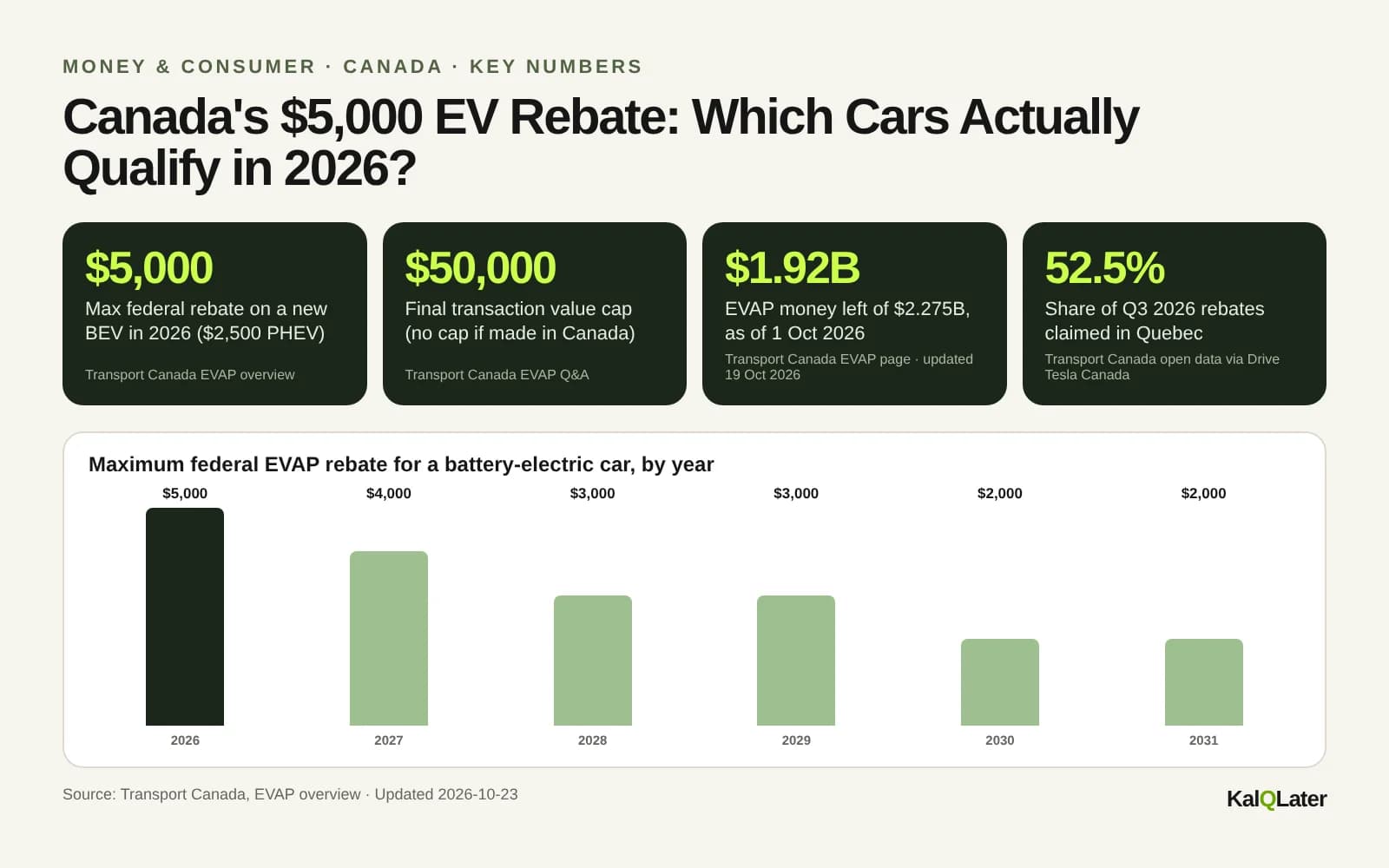
In 2026 Canada's federal EV rebate pays up to $5,000 on a new battery-electric car and $2,500 on a plug-in hybrid, if the final transaction value is $50,000 or less and the car is built in Canada or a free-trade-agreement country. China-built cars, including the Tesla Model 3, are out. Canadian-built models have no price cap. The amount drops to $4,000 on 1 January 2027.
The short answer: which cars qualify for Canada's EV rebate?
More than 30 models (33 in Drive Tesla Canada's October tracker) qualify at their starting price for the full $5,000 or $2,500 in 2026, but only if the deal you sign stays at or under $50,000 before tax. The Chevrolet Bolt, Tesla Model Y RWD, Chevrolet Equinox EV, Ford Mustang Mach-E and Toyota bZ were the five most-claimed cars in Q3 2026.
The Electric Vehicle Affordability Program (EVAP) covers new electric cars bought or leased from 16 February 2026 to 31 March 2031, or until the money runs out. It replaced the old iZEV rebate, which had paused after running out of funds in early 2025.
The headline number is real, but three rules decide whether you actually get it: the $50,000 final transaction value cap, the country of manufacture, and the year the dealer files your claim. Miss any one and the rebate is zero, or smaller than you expected.
Our verdict: if you live in Quebec or Manitoba and were already shopping for a sub-$50,000 EV, 2026 is the cheapest year this decade to buy. Elsewhere, the federal rebate alone cuts about 11% off a typical $46,000 electric SUV.
How does the $50,000 cap work? (It is not MSRP)
The cap applies to the final transaction value, not the sticker price. Transport Canada counts the MSRP, options, accessories and dealer or admin fees, minus any discounts. Freight, PDI, taxes, winter tires, extended warranties and a Level 2 charger are excluded.
This matters because a car listed at $49,990 can still fail. When the program was announced, Drive Tesla Canada reported that a $26 tire fee could push a $49,990 Tesla Model Y RWD over the line. Discounts work in your favour: Transport Canada says manufacturer and dealer discounts reduce the final transaction value in full.
- Counted in the $50,000 MSRP, accessories, optional packages, dealer, service and admin fees, minus manufacturer and dealer discounts.
- Not counted Freight and PDI, extended warranties, insurance products, one set of winter tires, a Level 2 charger, financing costs, trade-ins, deposits, sales and luxury taxes, registration and provincial incentives.
- Origin rule Only EVs made in Canada or a country with a free-trade agreement with Canada qualify. China has no such agreement, so China-built cars get nothing at any price.
- Made-in-Canada exemption Canadian-built EVs have no price cap. On the official list that means the Dodge Charger Daytona and the Chrysler Pacifica plug-in hybrid.
- One per person Individuals get one incentive over the life of the program. Businesses and fleets get up to 10, and approved carsharing companies up to 50 per calendar year.
Leases of 48 months or more get the full amount. Shorter leases are prorated at (full incentive ÷ 48) × months, with a 12-month minimum. In 2026 a 39-month lease earns $4,062 on a BEV and a 12-month lease earns $1,250.
Which EVs are eligible for the federal rebate in 2026?
The official EVAP vehicle list has 131 trim-level entries, all with a manufacturer MSRP of $50,000 or less (or made in Canada). The table shows the best-known models, their starting prices and the maximum rebate for a purchase or 48-month lease in 2026.
| Model | Type | Starting MSRP | Max federal rebate (2026) | Made in Canada (no cap)? |
|---|---|---|---|---|
| Chevrolet Bolt LT / RS (2027) | BEV | $39,999 | $5,000 | No |
| Fiat 500e | BEV | $39,995 | $5,000 | No |
| Ford Mustang Mach-E Select RWD | BEV | $44,995 | $5,000 | No |
| Toyota bZ XLE FWD | BEV | $45,990 | $5,000 | No |
| Chevrolet Equinox EV LT | BEV | $46,199 | $5,000 | No (built in Mexico) |
| Hyundai Kona Electric Preferred | BEV | $46,966 (all-in, incl. freight) | $5,000 | No |
| Tesla Model Y RWD | BEV | $49,990 | $5,000 | No (built in Germany) |
| Dodge Charger Daytona R/T | BEV | $54,995 | $5,000 | Yes |
| Toyota Prius Plug-in Hybrid | PHEV | $41,080 | $2,500 | No |
| Ford Escape Plug-in Hybrid | PHEV | $41,599 | $2,500 | No |
| Toyota RAV4 Plug-in Hybrid | PHEV | $48,750 | $2,500 | No |
| Chrysler Pacifica Plug-in Hybrid | PHEV | $59,995 | $2,500 | Yes |
Other models priced under the cap in Drive Tesla Canada's October 2026 tracker include the Kia EV3 ($36,995), Kia EV4 ($38,995), Nissan Leaf ($34,998), Volvo EX30 ($44,000) and Nissan Ariya ($48,998). Being on the list does not guarantee your deal qualifies, and a car not on the list can still qualify if your final transaction value is $50,000 or less.
- Tesla Model 3: not eligible Starts at $39,490 but is built in Shanghai, so the origin rule excludes it.
- Tesla Model Y Premium AWD: not eligible At $64,990 it is over the cap and not Canadian-built.
- Hyundai Ioniq 5: usually not eligible The cheapest 2026 trim starts at $58,466 after Hyundai dropped the $55,966 base model, so only a large discount would bring it under $50,000.
- BYD and other China-built EVs: never eligible Excluded on origin, whatever the price.
Which cars are Canadians actually claiming the rebate on?
The Chevrolet Bolt led Q3 2026 with 5,637 rebates, followed by the Tesla Model Y (3,336) and Chevrolet Equinox EV (3,311). In total 34,486 rebates worth $151.7 million were issued in Q3, 14.3% fewer than in Q2.
Top five models by EVAP rebates, Q3 2026
Source: Transport Canada EVAP open data (Sep 2026 release) via Drive Tesla CanadaView the data
| Label | Value |
|---|---|
| Chevrolet Bolt | 5,637 |
| Tesla Model Y | 3,336 |
| Chevrolet Equinox EV | 3,311 |
| Ford Mustang Mach-E | 2,942 |
| Toyota bZ | 2,574 |
Battery-electric cars took 28,542 of the 34,486 Q3 rebates, or 82.8% by our calculation. Plug-in hybrids made up the rest.
Geography is lopsided. Quebec accounted for 18,115 rebates (52.5%), Ontario 7,356 (21.3%) and British Columbia 6,022 (17.5%). Every other province and territory combined claimed 2,993. Quebec's lead lines up with its own stackable $2,000 rebate and its high leasing rate: about 49% of Quebec claims in August were leases.
Can you stack the federal rebate with provincial EV rebates?
Yes. Transport Canada applies the federal incentive on top of any provincial program, but only Quebec ($2,000) and Manitoba ($4,000) still pay a meaningful new-EV rebate in late 2026. BC's Go Electric rebate is paused, and Ontario has had none since 2018.
| Province | New BEV rebate | Status and key rules |
|---|---|---|
| Quebec (Roulez vert) | $2,000 | PHEV $1,000 (15 kWh+) or $500 (8 to 15 kWh). Based on registration date. Program ends 31 Dec 2026; $0 in 2027. |
| Manitoba | $4,000 | Extended in Budget 2026. MSRP under $70,000. Excludes Tesla and China-built EVs. Used EV $2,500. |
| British Columbia | $0 | CleanBC Go Electric passenger rebate paused; no pre-approvals accepted. |
| Ontario | $0 | No provincial rebate. |
| Alberta, Saskatchewan | $0 | No rebate; annual EV fees of $200 (AB) and $300 (SK) reported. |
| Atlantic Canada and territories | $0 in most cases | Newfoundland and Labrador closed 15 Mar 2026; Yukon ended 31 Mar 2026; PEI reported paused 15 Apr 2026. |
Quebec's rebate has been shrinking on a fixed schedule: $7,000 for a new BEV registered in 2024, $4,000 in 2025, $2,000 in 2026 and nothing in 2027. Manitoba's page says the program was extended in Budget 2026 but does not give a new end date, so check before you sign.
What do popular EVs really cost after the rebate?
A 2027 Chevrolet Bolt drops from $39,999 to $34,999 with the federal rebate alone, $32,999 in Quebec and $30,999 in Manitoba. A Toyota bZ XLE falls from $45,990 to $40,990 in Ontario or BC and $36,990 in Manitoba.
| Model | Starting MSRP | ON / BC / AB (federal only) | Quebec (+ Roulez vert) | Manitoba (+ MB rebate) |
|---|---|---|---|---|
| Chevrolet Bolt LT | $39,999 | $34,999 | $32,999 | $30,999 |
| Toyota bZ XLE FWD | $45,990 | $40,990 | $38,990 | $36,990 |
| Chevrolet Equinox EV LT | $46,199 | $41,199 | $39,199 | $37,199 |
| Toyota Prius Plug-in Hybrid | $41,080 | $38,580 | $37,580 to $38,080 | Not confirmed for PHEVs |
These are starting prices before freight, PDI and dealer fees, and before tax. Toyota's own all-in estimate for the bZ range starts at $49,648, so about $3,658 of fees and charges sit on top of the $45,990 MSRP. Freight and PDI do not count toward the $50,000 cap, but dealer admin fees do.
Because tax is charged on the full price, an Ontario buyer pays 13% HST on $45,990 for a bZ, about $5,979, even though the rebate then removes $5,000. The rebate lowers what you finance, not your tax bill.
How much will you save on fuel over five years?
Driving 15,000 km a year, a Toyota bZ saves about $7,100 to $8,900 in fuel over five years versus a gas Honda CR-V, at 2026's average gas price of $1.69 a litre. Savings are largest in Quebec, where electricity is cheapest.
| City (electricity price) | Gas cost at $1.69/L | Electricity cost | 5-year saving | Saving at $1.86/L |
|---|---|---|---|---|
| Montreal (8.29¢/kWh) | $9,886 | $996 | $8,890 | $9,885 |
| Winnipeg (10.53¢/kWh) | $9,886 | $1,265 | $8,621 | $9,616 |
| Vancouver (12.60¢/kWh) | $9,886 | $1,514 | $8,373 | $9,367 |
| Toronto (15.57¢/kWh) | $9,886 | $1,871 | $8,016 | $9,010 |
| Calgary (22.90¢/kWh) | $9,886 | $2,751 | $7,135 | $8,130 |
- Distance 15,000 km a year for five years (75,000 km). This is a KalQLater assumption; scale the result up or down for your own driving.
- Electric car Toyota bZ XLE FWD rated 1.8 Le/100 km. Using NRCan's conversion of 8.9 kWh per litre, that is 16.0 kWh/100 km, or 12,015 kWh over 75,000 km.
- Gas car Honda CR-V at 7.8 L/100 km combined, the lower of its two NRCan ratings, so the saving is conservative. That is 5,850 litres.
- Gas price $1.69/L, Kalibrate's 2026 year-to-date national average, with $1.86/L (week of 13 Oct 2026) as a high case.
- Electricity Hydro-Québec's April 2025 comparison of residential prices at 1,000 kWh a month, excluding taxes. Hydro-Québec raised its residential rates 3% on 1 April 2026.
Alberta drivers pay less for gas, $1.56/L on 13 October 2026. At that price the Calgary saving shrinks to about $6,375. Public fast charging costs much more than home power, so drivers who cannot charge at home will save less.
How much will the EV rebate be in 2027 and beyond?
The federal BEV rebate falls to $4,000 in 2027, $3,000 in 2028 and 2029, and $2,000 in 2030 and 2031. Plug-in hybrids step down from $2,500 to $2,000, $1,500 and $1,000. The amount is set by the year the dealer submits your eligibility assessment, not the delivery date.
Maximum federal EVAP rebate for a battery-electric car, by year
Source: Transport Canada, EVAP overviewView the data
| Label | Value |
|---|---|
| 2026 | $5,000 |
| 2027 | $4,000 |
| 2028 | $3,000 |
| 2029 | $3,000 |
| 2030 | $2,000 |
| 2031 | $2,000 |
Transport Canada's notice is explicit: the 2027 amount applies to any eligibility assessment the dealer submits on or after 1 January 2027, even if you ordered earlier. An assessment is valid for 90 days, so a dealer can lock in the 2026 amount for a car arriving in early 2027 if they file before year-end.
Quebec buyers face a second deadline. Roulez vert is based on the registration date, and amounts are not protected by an earlier order or deposit, so a car registered in January 2027 gets $0 from Quebec.
Has the rebate brought EV sales back?
Partly. New ZEV registrations rose 27% year over year to 58,811 in Q2 2026, but their share of the market was flat at 10.7%, well below the 18.3% peak of Q4 2024. The rebate stopped the slide; it has not restored 2024 levels.
ZEV share of new vehicle registrations in Canada, by quarter
Source: Statistics Canada new motor vehicle registrations (via StatCan Daily and Electric Autonomy)View the data
| Label | Value |
|---|---|
| Q2 2024 | 12.9% |
| Q3 2024 | 15.7% |
| Q4 2024 | 18.3% |
| Q1 2025 | 8.7% |
| Q2 2025 | 8.6% |
| Q3 2025 | 9.7% |
| Q4 2025 | 11.2% |
| Q1 2026 | 10.8% |
| Q2 2026 | 10.7% |
Annual figures tell the same story. ZEVs were 11.0% of new registrations in 2023, 14.6% in 2024 and 9.5% in 2025, according to Statistics Canada. The 2025 drop followed the iZEV pause.
In Q2 2026, battery-electric vehicles held 7.4% of new registrations and plug-in hybrids 3.3%. Quebec (17.8%) and BC (18.7%) remain far ahead of Ontario (8.2%), even though BC has no provincial rebate at the moment.
What happened to the EV mandate and Chinese EV tariffs?
Ottawa scrapped the EV sales mandate in February 2026 and replaced it with tighter greenhouse gas rules for 2027 to 2032 model years. Separately, a January 2026 deal lets up to 49,000 Chinese EVs a year in at a 6.1% tariff, but those cars still get no federal rebate.
The timeline is often garbled online. The 60-day review of the Electric Vehicle Availability Standard was announced on 5 September 2025, when the government removed the 2026 target of 20% zero-emission sales. In February 2026, alongside the new rebate, the government dropped the sales-quota approach entirely. Drive Tesla Canada reported officials estimate EVs could still reach about 75% of new sales by 2035 under the emissions rules.
On China, Canada imposed a 100% tariff on Chinese-built EVs in October 2024. On 16 January 2026 Prime Minister Mark Carney announced a tariff-quota deal: up to 49,000 Chinese EVs a year at 6.1%, which he said roughly matches 2023 import levels and is under 3% of the market. He also said half of those imports should cost less than $35,000 by 2030.
Headlines in October 2026 saying Canada 'may revive EV rebates and reassess Chinese tariffs' recycle a Motor Illustrated report from 3 November 2025. Both things have since happened: the rebate returned on 16 February 2026 and the China quota deal was struck on 16 January 2026.
How do you claim the EV rebate in Canada?
You do not apply yourself: an enrolled dealer checks eligibility through Transport Canada's EVAP portal and takes the rebate off your bill of sale or lease. No deposit is needed and there is no cheque later. Dealer participation is voluntary, so ask first.
- 1Confirm the dealer is enrolled
Only enrolled dealerships or authorized sellers can submit claims. Ask before you negotiate.
- 2Check the car's origin and the list
Look the trim up on the EVAP vehicle list. Avoid China-built models; check for the made-in-Canada marker if the price is above $50,000.
- 3Get the final transaction value in writing
Ask for the pre-tax total with MSRP, options and dealer fees, minus discounts, and excluding freight and PDI. It must be $50,000 or less.
- 4Sign the consent and attestation forms
The dealer sends your Consumer Consent Form to Transport Canada for an eligibility assessment, valid for 90 days. You then sign an Attestation Form.
- 5File before 31 December 2026
The dealer's submission date sets the amount. A 2026 filing locks $5,000; a 2027 filing gets $4,000.
- 6Add your provincial rebate
In Quebec, register the car by 31 December 2026 for $2,000. In Manitoba, apply for the $4,000 if the car is not a Tesla or China-built.
- 7Leasing? Choose 48 months
A 48-month lease gets the full amount. A 24-month lease gets half.
Claims vs evidence
“Canada brought back a $5,000 EV rebate.”
EVAP launched 16 Feb 2026 with up to $5,000 for BEVs and $2,500 for PHEVs, but only for 2026; it falls to $4,000 in 2027.
True“Any EV with an MSRP under $50,000 qualifies.”
The cap applies to the final transaction value including dealer fees and options, and China-built cars such as the $39,490 Tesla Model 3 are excluded regardless of price.
Misleading“Canada scrapped its EV sales mandate.”
In Feb 2026 the government replaced the sales quotas with greenhouse gas rules for model years 2027 to 2032.
True“The government paused the ZEV mandate for a 60-day review in September 2026.”
The pause and 60-day review were announced on 5 September 2025, not 2026.
False“The new rebate has revived EV sales.”
ZEV registrations rose 27% year over year in Q2 2026, but market share was flat at 10.7%, below 2024's 14.6% annual share.
Partly true“The rebate money is about to run out.”
Transport Canada reported $1.92B of $2.275B still available on 1 Oct 2026.
FalseFrequently asked questions
What cars qualify for the $5,000 EV rebate in Canada?
New battery-electric or fuel cell cars built in Canada or a free-trade-agreement country with a final transaction value of $50,000 or less. Popular examples include the Chevrolet Bolt ($39,999), Toyota bZ ($45,990), Chevrolet Equinox EV ($46,199) and Tesla Model Y RWD ($49,990). Canadian-built cars like the Dodge Charger Daytona have no price cap.
Does the Tesla Model 3 qualify for the Canadian EV rebate?
No. The Model 3 sold in Canada is built in Shanghai, and EVAP only covers vehicles made in Canada or countries with a free-trade agreement with Canada. The Germany-built Model Y RWD at $49,990 does qualify if the final transaction value stays at or under $50,000.
Is the $50,000 limit based on MSRP?
No. Transport Canada uses the final transaction value: MSRP plus options, accessories and dealer or admin fees, minus discounts. Freight, PDI, taxes, winter tires, extended warranties and a home charger are excluded. MSRP is only used to build the official vehicle list.
How much is the EV rebate in 2027?
Up to $4,000 for a battery-electric car and $2,000 for a plug-in hybrid. It then drops to $3,000 and $1,500 in 2028 and 2029, and $2,000 and $1,000 in 2030. The amount depends on the year the dealer submits your eligibility assessment.
Can I combine the federal EV rebate with Quebec's Roulez vert?
Yes. The federal incentive is applied on top of provincial programs. In 2026 Roulez vert adds $2,000 for a new BEV, so a Quebec buyer can get up to $7,000. Roulez vert ends on 31 December 2026 and is based on the registration date.
Do I get the EV rebate if I lease?
Yes, if the lease is at least 12 months. A 48-month lease gets the full $5,000. Shorter leases are prorated: 39 months earns $4,062, 24 months $2,500 and 12 months $1,250 for a BEV in 2026.
Do I have to apply for the EV rebate myself?
No. Only enrolled dealers or authorized sellers can submit claims. The dealer checks eligibility with Transport Canada and applies the rebate directly on your bill of sale or lease, after taxes and fees. There is no cheque by mail.
Are Chinese EVs eligible for the rebate after the tariff deal?
No. The January 2026 deal allows up to 49,000 Chinese EVs a year at a 6.1% tariff, but China has no free-trade agreement with Canada, so China-built EVs remain excluded from EVAP at any price.
How we built this analysis
- Program rules (amounts, cap definition, origin, lease proration, claim process, budget) were taken from Transport Canada's EVAP overview, Q&A, vehicle list and main program pages, read on 23 October 2026.
- Starting MSRPs come from Drive Tesla Canada's October 2026 price tracker, Electric Autonomy (Toyota bZ) and Guide Auto (Hyundai Kona Electric, all-in price). Effective price = MSRP − federal rebate − provincial rebate, e.g. Bolt in Manitoba: $39,999 − $5,000 − $4,000 = $30,999. Freight, fees and tax excluded.
- Fuel savings: 15,000 km/yr × 5 = 75,000 km. Gas: 7.8 L/100 km × 750 = 5,850 L × $1.69 = $9,886. EV: 1.8 Le/100 km × 8.9 kWh/L = 16.02 kWh/100 km × 750 = 12,015 kWh × city price (e.g. Toronto 15.57¢ = $1,871). Saving = gas cost − electricity cost.
- Rebate shares: Quebec 18,115 ÷ 34,486 = 52.5%; BEV share 28,542 ÷ 34,486 = 82.8%. Budget committed: $2.275B − $1.92B = $0.355B (15.6%). Claims estimate: $355M ÷ ($195M ÷ 44,700) ≈ 81,000, rounded to 'around 80,000'.
- ZEV shares are Statistics Canada figures as published in StatCan Daily releases and reported by Electric Autonomy; Q1 2026 share checked as 43,113 ÷ 397,601 = 10.8%.
- Each claim in the scorecard was checked against the primary document or the dated original news report.
Limitations
Transport Canada's vehicle list is published trim by trim and changes over time; we could not read all 131 entries, so the table shows selected models and some prices come from a trade publication rather than manufacturer pages. Starting MSRPs exclude freight, PDI and dealer fees, which vary by dealer and province. Fuel savings use a single assumed distance, taxes-excluded electricity rates from April 2025 and national average gas prices; your results will differ. Rebate counts are requests received, not paid rebates, and may be revised. Program rules can change and funding is first-come, first-served. This is general information, not financial or legal advice; confirm eligibility with your dealer before you sign.
Spotted an error? See our corrections policy. Read how we work in our methodology and editorial standards.
Sources
- Transport CanadaElectric Vehicle Affordability ProgramProgram dates, $2.275B budget, $1.92B remaining at 1 Oct 2026; updated 19 Oct 2026
- Transport CanadaElectric Vehicle Affordability Program overviewIncentive schedule 2026–2031, lease rules, claim process
- Transport CanadaElectric Vehicle Affordability Program: Questions and answersFinal transaction value definition, origin rule, lease proration table, stacking
- Transport CanadaEVAP vehicle list131 eligible entries; made-in-Canada marker
- Gouvernement du QuébecProgramme Roulez vert2024–2027 amounts; ends 31 Dec 2026; updated 5 Oct 2026
- Government of ManitobaManitoba Electric Vehicle Rebate Program$4,000 new / $2,500 used; extended in Budget 2026; exclusions
- Government of British ColumbiaCleanBC Go Electric Passenger Vehicle RebateProgram paused
- Statistics CanadaThe Daily: New motor vehicle registrations, Q2 2025Q4 2024 18.3%, Q1 2025 8.7%, Q2 2025 8.6%
- Statistics CanadaThe Daily: New motor vehicle registrations, 2025Annual ZEV share 2024 14.6%, 2025 9.5%
- Electric Autonomy CanadaZEV market share flat at 10.7 per cent for Q2: StatsCanQ1 and Q2 2026 StatCan registrations by province and powertrain
- Drive Tesla CanadaQuebec leads the nation in EVAP rebates in Q3 as total rebates dropAnalysis of Transport Canada EVAP open data, Q3 2026
- Drive Tesla CanadaCanada brings back $5,000 EV rebate, scraps EV sales mandateFeb 2026 announcement, mandate replaced by GHG rules
- Drive Tesla CanadaEV Rebates in Canada (2026)Starting MSRPs of eligible models, Oct 2026
- CP24 / The Canadian PressCarney reaches 'landmark' tariff-quota deal with China on EVs, canola49,000 quota at 6.1% tariff, 16 Jan 2026
- Hydro-QuébecComparison of Electricity Prices in Major North American Cities 2025Residential ¢/kWh at 1,000 kWh/month, 1 Apr 2025