Are Black Friday 2026 Deals Real When Inflation Is 3.7%?
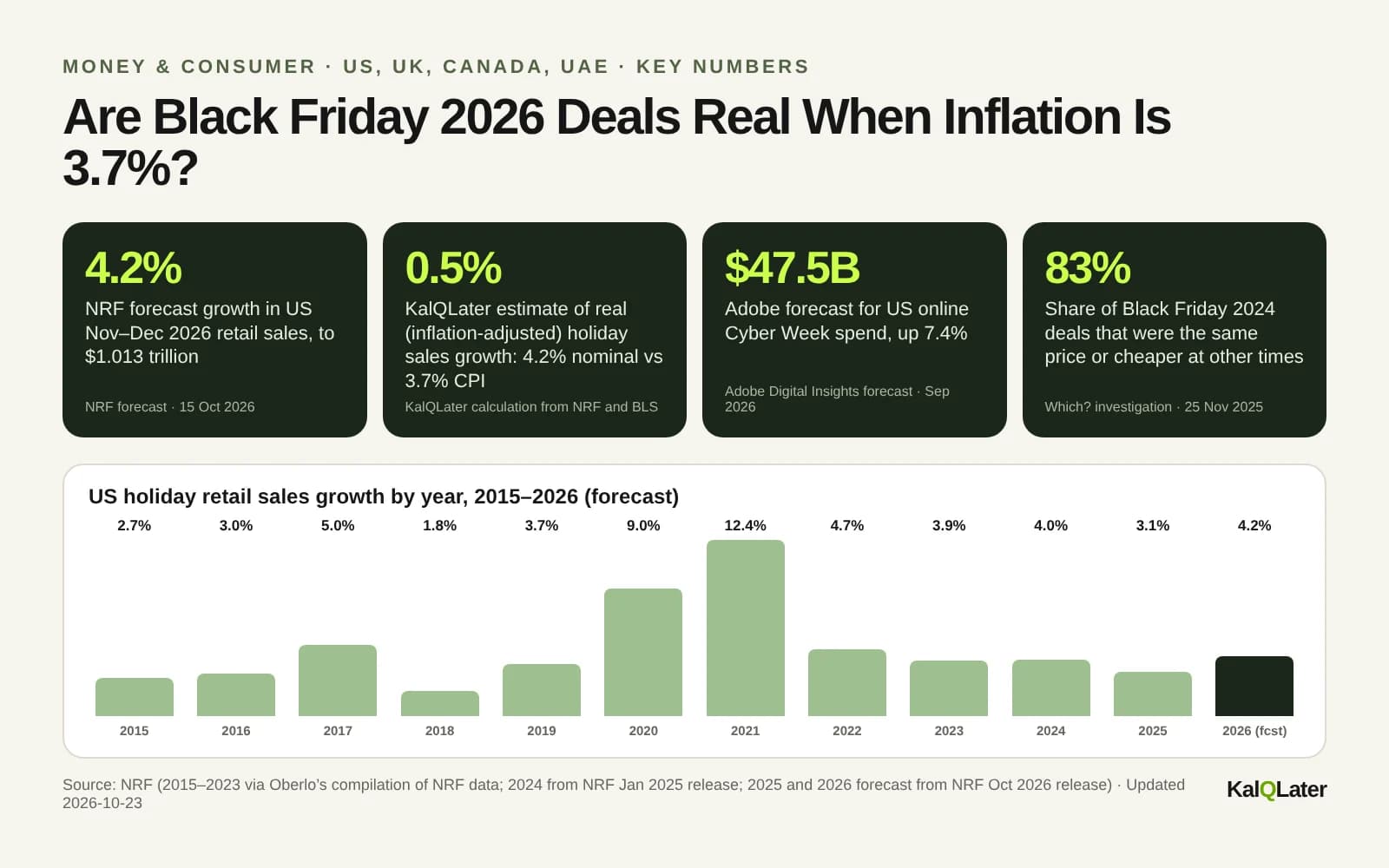
Some Black Friday 2026 deals are real, but most are not as big as they look: Which? found 83% of tracked Black Friday deals were the same price or cheaper at other times of the year. With US inflation at 3.7%, prices for toys (+6.6%) and computers (+9.7%) rose over the past year, while TVs (-1.9%) and furniture (-2.4%) fell. Check the price history before you buy.

The short answer: real deals exist, but the average 'saving' is overstated
Black Friday 2026 (27 November) will see record spending, but not record savings. Adobe forecasts peak online discounts of up to 30% during Cyber Week, yet UK consumer group Which? found 83% of Black Friday deals it tracked were matched or beaten at other times, and none were at their lowest price of the year on Black Friday itself.
The trend is clear: shoppers keep spending more each holiday season. The National Retail Federation (NRF) forecasts November and December 2026 retail sales will grow 4.2% to $1.013 trillion. Adobe forecasts US online sales of $275.1 billion for the season, up 6.7%.
The reality is more mixed. Consumer prices rose 3.7% in the year to September 2026, according to the Bureau of Labor Statistics (BLS). Once you strip that out, our calculation suggests NRF’s forecast implies real growth of only about 0.5%. Shoppers are paying more, but not necessarily getting more.
On the deals themselves, the best evidence comes from the UK, where Which? tracks individual prices for a year around Black Friday. Its latest study found most 'deals' were available at the same price or lower before or after the event. US retailers are not covered by that study, but many of the same brands and products are sold in both markets.
How big will holiday 2026 spending be? NRF forecasts $1.013 trillion
NRF forecasts US holiday retail sales will rise 4.2% in 2026 to $1.013 trillion, faster than the 3.1% growth NRF now reports for 2025. That would be the strongest growth since 2022, but well below the stimulus-era jumps of 2020 and 2021.
NRF’s forecast covers 1 November to 31 December and excludes car dealers, gas stations and restaurants. NRF said in its 15 October 2026 release that last year’s holiday sales rose 3.1% over 2024 to $972 billion. It also expects retailers to hire 325,000 to 375,000 seasonal workers, compared with an estimated 356,000 last year.
US holiday retail sales growth by year, 2015–2026 (forecast)
Source: NRF (2015–2023 via Oberlo’s compilation of NRF data; 2024 from NRF Jan 2025 release; 2025 and 2026 forecast from NRF Oct 2026 release)View the data
| Label | Value |
|---|---|
| 2015 | 2.7% |
| 2016 | 3.0% |
| 2017 | 5.0% |
| 2018 | 1.8% |
| 2019 | 3.7% |
| 2020 | 9.0% |
| 2021 | 12.4% |
| 2022 | 4.7% |
| 2023 | 3.9% |
| 2024 | 4.0% |
| 2025 | 3.1% |
| 2026 (fcst) | 4.2% |
NRF’s chief economist said 'inflation, rising gas prices and pressure on household spending will affect consumers differently across income groups.' In other words, the headline total can grow even while many households cut back.
Deloitte’s 2026 holiday survey of 4,000 US consumers points the same way. It found planned average household holiday spending of $1,654, up 4% from $1,595 in 2025, with spending on retail goods up 10% to $988 and spending on holiday activities down 4% to $666.
Is holiday spending really growing once you adjust for inflation?
Barely. Adjusted for 3.7% inflation, NRF’s 4.2% forecast is about 0.5% real growth, and Deloitte’s planned per-household rise of $59 is exactly 3.7%, meaning zero real growth. Online spending looks stronger, at roughly 2.9% real growth on Adobe’s forecast.
Retail forecasts are in nominal dollars. If prices rise 3.7%, a shopper who spends 3.7% more is buying the same amount of stuff. To see real growth, we divide each forecast by the price change. We use the all-items CPI (3.7%) as the main deflator and core CPI (2.6%) as a lower bound, because gasoline is up sharply and NRF excludes gas stations.
| Measure | Nominal growth (forecast) | Real growth at 3.7% CPI | Real growth at 2.6% core CPI |
|---|---|---|---|
| NRF holiday retail sales | 4.2% | 0.5% | 1.6% |
| Deloitte avg household spend ($1,595 to $1,654) | 3.7% | 0.0% | 1.1% |
| Adobe online holiday season | 6.7% | 2.9% | 4.0% |
| Adobe online Cyber Week | 7.4% | 3.6% | 4.7% |
The online numbers look healthier partly because spending keeps shifting from stores to the web. That means some of Adobe’s growth is the same money moving channels, not new money. Neither Adobe’s forecast release nor NRF’s adjusts for inflation.
How much will Americans spend online over Black Friday and Cyber Monday 2026?
Adobe forecasts $47.5 billion of US online spending across Cyber Week 2026 (Thanksgiving to Cyber Monday), up 7.4%. It expects Cyber Monday (30 November) to hit $15.1 billion and Black Friday $12.9 billion, with Black Friday growing faster at 9.2%.
US online Cyber Week spending, 2023–2026 (forecast), $ billions
Source: Adobe Digital Insights (Cyber Monday recaps 2023, 2024; 2025 season recap; 2026 forecast)View the data
| Label | Value |
|---|---|
| 2023 | $38.0B |
| 2024 | $41.1B |
| 2025 | $44.2B |
| 2026 (fcst) | $47.5B |
That is a 25% rise in nominal Cyber Week spending in three years, from $38.0 billion in 2023 to a forecast $47.5 billion. Adobe has said in earlier years that online prices were falling, which made real growth look stronger. In 2026 the backdrop is different: overall consumer prices are rising faster than at any point in the past two years.
Adobe forecasts discounts peaking at up to 30% off listed prices during Cyber Week, with up to 21% just before Thanksgiving and 10–15% in December. Those are averages off the retailer’s own listed price, which matters for the next two sections.
Which Black Friday goods are getting cheaper, and which are rising?
Typical Black Friday categories are split: TVs (-1.9%), furniture (-2.4%), major appliances (-2.3%) and smartphones (-9.9%) are cheaper than a year ago, while computers (+9.7%), jewelry (+10.8%) and toys (+6.6%) cost more. The 3.7% headline is driven mainly by energy, not by the goods people buy on Black Friday.
12-month price change for typical Black Friday goods, US CPI, September 2026
Source: BLS, CPI Table 2, September 2026 (not seasonally adjusted)View the data
| Label | Value |
|---|---|
| Jewelry and watches | 10.8% |
| Computers, peripherals, smart home | 9.7% |
| Toys | 6.6% |
| Sporting goods | 4.7% |
| All items (headline) | 3.7% |
| Apparel | 3.4% |
| Footwear | 3.4% |
| Video and audio products | 1.9% |
| Televisions | -1.9% |
| Major appliances | -2.3% |
| Furniture and bedding | -2.4% |
| IT commodities | -2.9% |
| Smartphones | -9.9% |
This split matters for deal hunters. If a TV’s price trend is already down 1.9% a year, a Black Friday discount comes on top of a falling price. If a laptop category is up 9.7%, part of any headline discount simply brings the price back to where it was last year.
BLS data do not explain why each category moved. Energy is the big driver of the headline: BLS reports energy up 20.4% and airline fares up 22.4% over the same 12 months, while core inflation (excluding food and energy) is 2.6%. For more on what is pushing prices, see our US inflation 3.7% explainer, and for travel costs see Thanksgiving flights 2026.
How big does a discount need to be to beat a year of inflation?
To get a computer back to last year’s price you need an 8.8% discount; for toys, 6.2%. Applying Adobe’s forecast peak discounts, the real saving versus last year’s price is about 24% on toys and TVs but only around 15% on computers and sporting goods.
If a product’s price rose by X% over the year, the discount that returns it to last year’s price is X / (1 + X). Then the 'real' discount compared with a year ago is 1 - (1 + X) × (1 - advertised discount). We applied Adobe’s 2026 forecast peak discount for each category to the matching BLS price change.
| Category | 12-month CPI change | Discount needed to match Sep 2025 price | Adobe forecast peak discount | Real saving vs a year ago |
|---|---|---|---|---|
| Toys | +6.6% | 6.2% | 29% | 24.3% |
| Computers | +9.7% | 8.8% | 23% | 15.5% |
| Sporting goods | +4.7% | 4.5% | 19% | 15.2% |
| Apparel | +3.4% | 3.3% | 23% | 20.4% |
| Televisions | -1.9% | None (already cheaper) | 23% | 24.5% |
| Major appliances | -2.3% | None (already cheaper) | 18% | 19.9% |
| Furniture | -2.4% | None (already cheaper) | 18% | 20.0% |
Worked example: a $1,000 laptop in a category up 9.7% would cost about $1,097 now. At 23% off, you pay about $845, which is 15.5% below what a comparable laptop cost a year ago, not 23%.
Are Black Friday deals real? What the Which? price tracking found
In Which?’s latest study, 83% of 175 Black Friday 2024 deals were the same price or cheaper at least once outside the sale period, and none were at their lowest price of the year on Black Friday itself. The share has fallen from 92% in the previous study, but most 'deals' still were not unique.
Which? tracked 175 home, tech and health products at Amazon, AO, Argos, Boots, Currys, John Lewis, Richer Sounds and Very from May 2024 to May 2025. It compared prices against the four-week Black Friday sale period of 15 November to 12 December 2024.
| Sale analysed | Products tracked | Same price or cheaper at other times | Published |
|---|---|---|---|
| Black Friday 2023 | 227 | 92% | 26 Nov 2024 |
| Black Friday 2024 | 175 | 83% | 25 Nov 2025 |
| Black Friday 2024: by retailer | - | John Lewis 94%, Very 93%, Amazon 88%, AO 85%, Currys 84%, Argos 79%, Richer Sounds 55% | 25 Nov 2025 |
Some examples are stark. A Samsung 55-inch TV at AO was £1,039 on Black Friday, dropped to £999 the next day, and was cheaper than its Black Friday price on 134 days in the following six months, with a low of £759. By our calculation, the Black Friday price was 37% above that later low.
Reference prices were also questionable. Boots advertised an Oral-B toothbrush as 'save £25, RRP £50', but Which? found the £50 price applied for only 13 days in the six months before the sale. Which? retail editor Reena Sewraz called Black Friday 'a false economy' for most shoppers.
How to spot a real Black Friday discount: price history and the 30-day rule
The simplest test is price history: compare the Black Friday price with the lowest price over the past 30 to 90 days, not with the 'was' price. In the EU, the law already requires announced reductions to be measured against the lowest price of the previous 30 days.
Under Article 6a of the EU’s Omnibus Directive, applied from 28 May 2022, any announced price reduction must show the prior price, defined as the lowest price the seller charged in at least the 30 days before the promotion. If a product was €40 at any point in the last 30 days, '20% off' must be calculated from €40.
The UK has no fixed 30-day law. Its regulator, the Competition and Markets Authority (CMA), polices misleading 'was' prices case by case under consumer protection law. The US has no 30-day rule either, so American shoppers have the least built-in protection of the three markets. (A widely shared claim that EU or UK rules use a 90-day lowest price is wrong: the EU minimum is 30 days.)
- Use a price tracker Which? recommends price-history tools such as PriceRunner or camelcamelcamel (Amazon only). Look at 90 days of history to cover pre-sale price rises.
- Ignore RRP and 'was' prices Compare with the lowest price actually charged recently, at that retailer and at rivals.
- Check the category trend Use the CPI chart above. A 20% discount on a category rising 10% a year is worth far less than it looks.
- Check the seller On marketplaces, see who sells and ships the item. Which? has found counterfeit electricals, toys and cosmetics on online marketplaces.
- Remember October Adobe forecast Prime Day (6–7 October 2026) discounts peaking at 19%. Many deals repeat, so missing Black Friday is rarely a disaster.
Is buy now, pay later a trap this Black Friday?
Adobe forecasts $21.3 billion of buy now, pay later (BNPL) spending in November and December 2026, up 6.6%, and late payments are rising: 47% of BNPL users told LendingTree they paid late in the past year. That is up from 34% in 2024.
Adobe expects BNPL to drive $1.09 billion of online spending on Cyber Monday and $807 million on Black Friday, with 82% of BNPL spending made on phones. Last season, BNPL spending reached $20 billion, up 9.8%.
LendingTree’s surveys show the strain. Among BNPL users, 63% have held multiple BNPL loans at once and 25% have held three or more. 29% have used BNPL for groceries, up from 14% two years earlier. In December 2025, a record 48% of Americans were at least considering a BNPL application.
Broader credit reliance is high too. NerdWallet’s October 2026 index, conducted by The Harris Poll, found 38% of Americans expect to rely on credit for at least some expenses this month, rising to 54% of parents of children under 18.
Black Friday in the UK, Canada and the UAE (White Friday)
UK inflation was 3.5% in September 2026, but clothing and footwear prices rose just 0.1% a year, making fashion one of the better Black Friday categories in Britain. Canada and the UAE follow the same 27 November Black Friday timing, with the UAE’s version branded White Friday.
In the UK, the Office for National Statistics reported CPI of 3.5% in the year to September 2026, up from 3.1% in August. Clothing and footwear rose only 0.1%, furniture and household goods 1.0%, and recreation and culture 2.3%. So UK shoppers face less category inflation on typical Black Friday goods than Americans, and the Which? findings apply directly to UK retailers.
In Canada, inflation has also picked up this year (see our Bank of Canada rate decision coverage for the latest figures). Many Canadian shoppers buy from US-based retailers, so the same price-history checks apply, and cross-border shipping and duties can cancel a discount.
In the UAE and wider Gulf, Black Friday is marketed as White Friday by major marketplaces and typically runs from late November into early December. We did not find a published UAE equivalent of the EU 30-day reference price rule in the sources we reviewed, so price tracking matters even more there.
What should you do before Black Friday 2026?
Make a list now, record today’s prices, and only buy on 27 November if the price beats the 90-day low. Prioritise categories where prices are already falling, such as TVs, appliances and furniture, and avoid funding gifts with BNPL you cannot repay on time.
- 1Write a list and a budget
Deloitte’s survey puts the average planned household spend at $1,654. Set your own number before the ads start.
- 2Record prices now
Note today’s price for each item and set price-drop alerts. This creates your own reference price.
- 3Check 90-day history on the day
Buy only if the Black Friday price is at or below the recent low, not just below the 'was' price.
- 4Adjust for category inflation
For toys and computers, subtract the year’s price rise from the headline discount to see the real saving (see our table).
- 5Compare after Black Friday
In the Which? study, a Samsung TV sold at £1,039 on Black Friday was £999 the very next day. Check return and price-match policies.
- 6Pay in full if you can
With 47% of BNPL users reporting late payments, treat instalments as debt, not as a discount.
Black Friday 2026 claims vs evidence
“Black Friday has the lowest prices of the year.”
Which? found none of 175 tracked deals were at their lowest price of the year on Black Friday itself, and 83% were matched or beaten outside the sale period.
False“Black Friday deals are all fake.”
17% of Which? tracked deals were not matched at other times, and at Richer Sounds only 55% were. Some categories, like TVs, are also falling in price.
Misleading“Record holiday spending shows consumers are strong.”
NRF forecasts 4.2% nominal growth, but that is about 0.5% after 3.7% inflation. Deloitte’s planned per-household rise is exactly 3.7%.
Partly true“3.7% inflation means everything on sale costs more this year.”
BLS shows TVs -1.9%, furniture -2.4%, appliances -2.3% and smartphones -9.9% over 12 months. Energy (+20.4%) drives the headline.
False“Discounts of 30% mean you save 30%.”
Adobe’s 30% is off listed prices. After a year of category inflation, a 23% computer discount is a 15.5% real saving, before any inflated 'was' price.
Misleading“BNPL is a safe way to spread holiday costs.”
47% of BNPL users paid late in the past year (LendingTree), up from 34% in 2024.
Partly trueFrequently asked questions
When is Black Friday 2026?
Black Friday 2026 is on Friday, 27 November 2026, the day after US Thanksgiving (26 November). Cyber Monday is 30 November. Adobe forecasts Black Friday online spending of $12.9 billion and Cyber Monday spending of $15.1 billion in the US, with Cyber Week totalling $47.5 billion.
Are Black Friday deals really cheaper?
Often not. Which? found 83% of 175 Black Friday 2024 deals were the same price or cheaper at least once outside the sale period, and none were at their lowest price of the year on Black Friday. Some deals are genuine, so check each item’s price history.
Is Black Friday the cheapest time of year to buy a TV?
Not reliably. US TV prices are already 1.9% lower than a year ago, and Adobe forecasts TV discounts peaking at 23%. But Which? found one Samsung TV was cheaper than its Black Friday price on 134 days in the following six months, falling as low as £759 from £1,039.
How much will Americans spend this holiday season?
NRF forecasts November–December 2026 retail sales of $1.013 trillion, up 4.2%. Adobe forecasts $275.1 billion online, up 6.7%. Deloitte’s survey puts average planned household spending at $1,654. All three are forecasts or surveys, and none adjusts for 3.7% inflation.
How do I know if a discount is real?
Compare the sale price with the lowest price over the past 30 to 90 days using a tracker such as camelcamelcamel or PriceRunner, not with the 'was' price or RRP. EU law already requires announced reductions to reference the lowest price of the previous 30 days.
Should I use buy now, pay later on Black Friday?
Only if you can repay on time. Adobe forecasts $21.3 billion of BNPL spending this November and December, and LendingTree found 47% of BNPL users paid late in the past year. Late fees can cancel out a 20% discount. This is not financial advice.
What is White Friday in the UAE?
White Friday is the name Gulf marketplaces use for their Black Friday sales, which typically run from late November into early December. The same advice applies: check price history, because we found no UAE rule equivalent to the EU’s 30-day lowest price requirement.
Do Black Friday discounts beat inflation in 2026?
Usually, yes, on paper. Toys need a 6.2% discount and computers 8.8% just to return to last year’s price. Adobe forecasts peak discounts of 29% and 23%, giving real savings of about 24% and 15.5%, if the listed price is honest.
How we built this analysis
- Real growth: (1 + nominal forecast growth) / (1 + inflation) - 1, using BLS all-items CPI of 3.7% and core CPI of 2.6% (September 2026, 12 months). Example: 1.042 / 1.037 - 1 = 0.48%.
- Deloitte per-household change: $1,654 / $1,595 - 1 = 3.7%, equal to headline CPI, so 0.0% real growth.
- Discount needed to offset a price rise X: X / (1 + X). Example for computers: 9.7 / 109.7 = 8.8%.
- Real saving vs a year ago: 1 - (1 + X) × (1 - D), where D is Adobe’s forecast 2026 peak category discount. Example for toys: 1 - 1.066 × 0.71 = 24.3%.
- Which? TV example: £1,039 / £759 - 1 = 36.9%, rounded to 37% above the post-sale low. Cyber Week three-year change: $47.5B / $38.0B - 1 = 25%.
- Category mapping between Adobe and BLS is approximate: Adobe 'computers' matched to BLS 'computers, peripherals, and smart home assistants'; Adobe 'appliances' to BLS 'major appliances'; Adobe 'furniture' to 'furniture and bedding'.
Limitations
Holiday totals for 2026 are forecasts and surveys, not results; final NRF and Adobe figures arrive in December 2026 and January 2027. NRF revises past years, so the growth chart mixes data vintages. Which? tracks UK retailers only and had not published 2025 or 2026 results as of 23 October 2026; there is no comparable large public US study. CPI measures quality-adjusted average prices, not the price of a specific product, and Adobe discounts are measured against listed prices that may themselves be inflated. Our real-saving figures are illustrative best cases. This article is general information, not financial advice.
Spotted an error? See our corrections policy. Read how we work in our methodology and editorial standards.
Sources
- US Bureau of Labor StatisticsConsumer Price Index, Table 2: CPI-U by expenditure category, September 2026Headline, core, energy, airline fares and category price changes
- National Retail FederationNRF Forecasts 2026 Holiday Sales Growth as Consumers Remain Resilient (15 Oct 2026)2026 forecast 4.2% / $1.013T; 2025 growth 3.1% / $972B; seasonal hiring
- National Retail FederationNRF says holiday season was a notable success (16 Jan 2025)2024 holiday growth 4% to $994.1B
- Oberlo (compiling NRF data)Holiday Retail Sales in the US (2012–2024)NRF holiday growth 2015–2023 (secondary compilation)
- AdobeAdobe: U.S. Holiday Shopping Season to Hit Record $275.1 Billion Online (Sep 2026)2026 forecasts: season, Cyber Week, key days, discounts, BNPL
- AdobeAdobe: Holiday Shopping Season Drove a Record $257.8 Billion Online (Jan 2026)2025 actuals: Cyber Week $44.2B, BNPL $20B, discounts
- AdobeAdobe Cyber Monday 2024 recap (Dec 2024)Cyber Week 2024 $41.1B
- AdobeAdobe: Cyber Monday Surges to $12.4 Billion (Nov 2023)Cyber Week 2023 $38B
- Which?Don't believe the hype: most Black Friday deals the same price or cheaper at other times of the year (25 Nov 2025)Black Friday 2024 study: 175 products, 83%, retailer breakdown, examples
- Which?Nine in 10 Black Friday deals cheaper or same price at other times of the year (26 Nov 2024)Black Friday 2023 study: 227 products, 92%
- DeloitteDeloitte: Holiday spending set to increase (15 Oct 2026)Survey: $1,654 average household spend, retail goods $988
- LendingTreeBuy Now, Pay Later Statistics (updated 14 Oct 2026)Survey: late payments, stacking, groceries, application consideration
- NerdWallet / The Harris PollNearly 2 in 5 Americans expect to rely on credit as inflation hits 3.7% (20 Oct 2026)Survey: 38% expect to rely on credit
- Office for National StatisticsConsumer price inflation, UK: September 2026UK CPI 3.5%; clothing, furniture, recreation
- RPC (on European Commission guidance)European Commission publishes guidance on price promotions under the Omnibus DirectiveEU Article 6a 30-day lowest prior price rule