Making Tax Digital 2027: Who Has to Sign Up, and What Changes From April?
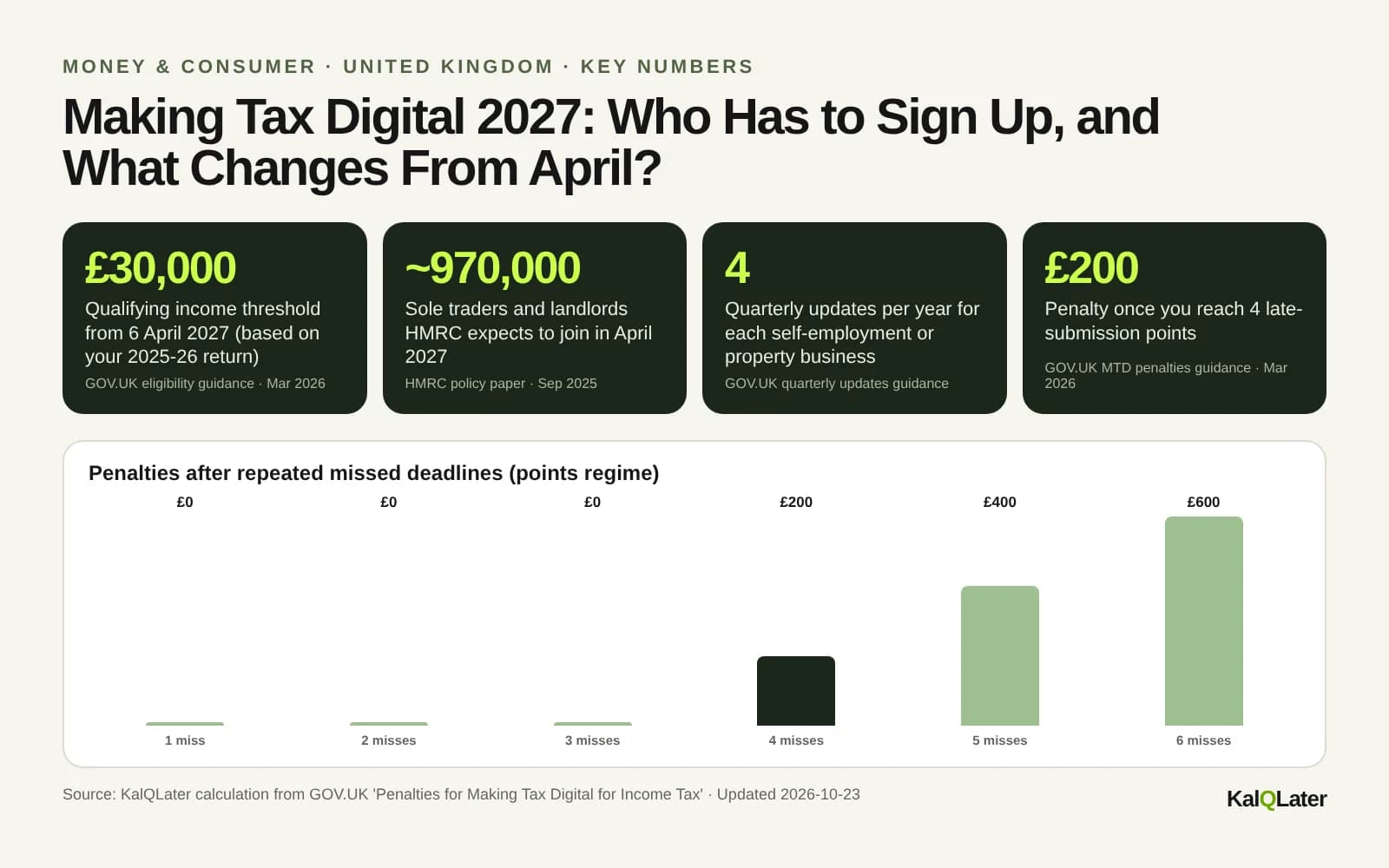
If your gross income from self-employment and property was over £30,000 in the 2025-26 tax year, you must use Making Tax Digital for Income Tax from 6 April 2027. HMRC estimates about 970,000 sole traders and landlords join in that phase. It counts turnover before expenses, not profit. The Budget on 28 October 2026 may bring updates; this page reflects the rules as of 23 October 2026.

The short answer: £30,000 of turnover, 6 April 2027
From 6 April 2027, Making Tax Digital for Income Tax (MTD) covers sole traders and landlords whose combined gross self-employment and property income was over £30,000 in 2025-26. HMRC decides using the Self Assessment return you file by 31 January 2027, and it estimates about 970,000 people are in this second wave.
MTD for Income Tax went live on 6 April 2026 for people with qualifying income over £50,000 in 2024-25. The second phase drops the threshold to £30,000, and a third phase drops it to £20,000 from 6 April 2028, based on 2026-27 income.
Joining means keeping digital records in compatible software, sending a short summary to HMRC every quarter, and filing your tax return from that software. It does not change how much tax you pay. It changes how often you report, and what happens if you miss a deadline.
The headline confusion is the word "income". HMRC means turnover before expenses, not profit. A plumber who invoices £45,000 and makes £12,000 profit is in from April 2027. An employee earning £60,000 with £8,000 of rent is not, because salary does not count.
Do I need Making Tax Digital, and from when?
Enter your gross (before-expenses) self-employment income and your share of gross property income for one tax year. We add them up the way HMRC does and tell you whether that year's figures put you into Making Tax Digital for Income Tax, from which date, and which deadlines follow. Rules as of 23 October 2026, before the Autumn Budget. Not tax advice.
- Qualifying income
- £0 (self-employment £0 + property £0)
- Result
- Not in this phase
Not required based on these figures. Qualifying income of £20,000 or less is currently exempt.
Don't include salary (PAYE), pensions, dividends or partnership profits. Each missed deadline = 1 penalty point; 4 points = £200. Based on GOV.UK guidance as of 23 October 2026, before the 28 October Budget. Not tax advice.
Making Tax Digital timeline: 2026, 2027 and 2028
There are three confirmed phases: over £50,000 from April 2026, over £30,000 from April 2027 and over £20,000 from April 2028. Each phase is decided by the tax return two years earlier. Partnerships are not yet included; HMRC says it will set out their timeline later.
| Start date | Qualifying income over | Decided by your return for | Return due by | People HMRC expects |
|---|---|---|---|---|
| 6 April 2026 | £50,000 | 2024-25 | 31 January 2026 | ~780,000 (2024 estimate); ~864,000 (HMRC data, Mar 2026) |
| 6 April 2027 | £30,000 | 2025-26 | 31 January 2027 | ~970,000 |
| 6 April 2028 | £20,000 | 2026-27 | 31 January 2028 | ~970,000 |
| Not set | n/a | n/a | n/a | Partnerships: timeline "at a later date" |
People brought into Making Tax Digital, by phase
Source: HMRC policy papers (Feb 2024, updated Sep 2025; Mar 2026); HMRC management information via ATT (Mar 2026)View the data
| Label | Value |
|---|---|
| Apr 2026 (2024 est.) | 780,000 |
| Apr 2026 (Mar 2026 data) | 864,000 |
| Apr 2027 | 970,000 |
| Apr 2028 | 970,000 |
Add the three official estimates together (780,000 + 970,000 + 970,000) and about 2.72 million people should be in MTD by April 2028. HMRC expected 12,029,168 Self Assessment returns for 2024-25, so that is roughly 22.6% of the Self Assessment population, a KalQLater calculation that mixes estimates from different years.
What counts as qualifying income for MTD?
Qualifying income is your total self-employment and property income before expenses, which HMRC calls turnover. Salary, pensions, dividends and your share of partnership profits do not count. For jointly owned property, only your share of the rent counts.
- Self-employment turnover (sales before expenses)
- UK property income, and foreign property if you were UK tax resident
- Your share of jointly owned property income
- Income from a source that stopped, if you still have another continuing source
- VAT, only if you use the cash basis, are VAT registered and choose to include it
- Employment income taxed through PAYE
- Dividends, including from your own company
- State Pension and private pensions
- Your share of partnership profit as a partner
- Transition profits from basis period reform, qualifying care relief, UK REIT or PAIF income
HMRC's own worked example: rental income of £25,000 plus self-employment income of £27,000 gives qualifying income of £52,000. That person was in from April 2026 if those were their 2024-25 figures.
For joint property, HMRC gives the example of siblings who jointly own a property earning £50,000 and split it equally. Each has qualifying income of £25,000. If you only receive your share after expenses are taken off, HMRC uses that net figure instead.
Am I affected? Six worked examples
A landlord with £18,000 of rent and £14,000 of self-employment turnover has £32,000 of qualifying income, so must start MTD in April 2027 if those are 2025-26 figures. The examples below apply HMRC's definitions to typical cases.
| Person | What counts | Qualifying income | Result |
|---|---|---|---|
| Landlord with a side business: £18,000 rent, £14,000 self-employment turnover | £18,000 + £14,000 | £32,000 | In from 6 April 2027 |
| Sole trader: £45,000 turnover, £12,000 profit | Turnover, not profit | £45,000 | In from 6 April 2027 |
| Joint landlord: £50,000 rent split 50/50 with a sibling, no other income | Own share only | £25,000 | Not in 2027; in from April 2028 if 2026-27 share is over £20,000 |
| Employee: £60,000 salary plus £8,000 rent | Salary excluded | £8,000 | Not in; £20,000 or less is exempt |
| Retired freelancer: £28,000 turnover, £15,000 pension, £10,000 dividends | Pension and dividends excluded | £28,000 | Not in 2027; likely April 2028 if 2026-27 is similar |
| HMRC example: £25,000 rent plus £27,000 self-employment (2024-25) | £25,000 + £27,000 | £52,000 | Should have started 6 April 2026 |
The arithmetic is deliberately simple: add gross self-employment income to your share of gross property income, then compare the total with the threshold for the year the figures relate to. Expenses, allowances and losses play no part in the test.
Use the calculator on this page to run your own numbers. It also lists your quarterly deadlines once you are in.
Which tax return decides whether I join in April 2027?
Your 2025-26 Self Assessment return, due by 31 January 2027, decides the April 2027 phase. HMRC reviews each return, checks qualifying income against the threshold, and writes to confirm you must start from the following tax year.
The gap is deliberate. HMRC looked at 2024-25 returns to decide the April 2026 group, and it will look at 2025-26 returns for April 2027. That leaves only about two months between filing your return in January 2027 and starting in April 2027, so it pays to know your number now.
Your 2025-26 tax year ended on 5 April 2026, so your figures are already fixed. If your books show more than £30,000 of combined turnover, you can plan on April 2027 without waiting for a letter.
Making Tax Digital quarterly deadlines for 2027-28
If you join on 6 April 2027, your first quarterly update is due by 7 August 2027, then 7 November 2027, 7 February 2028 and 7 May 2028. Your 2027-28 tax return, filed from MTD software, follows the usual 31 January deadline, which falls on 31 January 2029.
| Update | Period covered (standard) | Period covered (calendar option) | Deadline |
|---|---|---|---|
| 1st | 6 April to 5 July 2027 | 1 April to 30 June 2027 | 7 August 2027 |
| 2nd | 6 April to 5 October 2027 | 1 April to 30 September 2027 | 7 November 2027 |
| 3rd | 6 April 2027 to 5 January 2028 | 1 April to 31 December 2027 | 7 February 2028 |
| 4th | 6 April 2027 to 5 April 2028 | 1 April 2027 to 31 March 2028 | 7 May 2028 |
| Tax return | Whole 2027-28 tax year | Whole 2027-28 tax year | 31 January 2029 |
Updates are cumulative: each one covers the tax year so far, so your software sends running totals, not just the latest three months. If you spot a mistake, you correct your records and the fix flows into the next update.
You send four updates a year for each self-employment and property business. A landlord who also runs a business has two sets of four, eight updates in all, though both sets share the same four deadlines.
Two things do not change. You still pay tax by the usual Self Assessment dates, and you still file a full return for the year. The return for 2025-26 (due 31 January 2027) is filed the normal way, even if you start MTD in April 2027.
MTD penalty points: what happens if you miss a deadline?
Each missed quarterly update or tax return deadline adds one penalty point, and reaching 4 points triggers a £200 penalty, with £200 more for every further miss. The April 2026 group had a year without points for late quarterly updates; GOV.UK does not say the April 2027 group gets the same.
Penalties after repeated missed deadlines (points regime)
Source: KalQLater calculation from GOV.UK 'Penalties for Making Tax Digital for Income Tax'View the data
| Label | Value |
|---|---|
| 1 miss | £0 |
| 2 misses | £0 |
| 3 misses | £0 |
| 4 misses | £200 |
| 5 misses | £400 |
| 6 misses | £600 |
- One point per missed deadline Missing a quarterly update (for tax years after 2026-27) or the tax return deadline earns a point. Several businesses missing the same deadline still means one point.
- £200 at 4 points Then another £200 for every further missed deadline while you are at the threshold.
- Clearing points Below the threshold, each point drops off after 24 months. At the threshold, you need 12 months of on-time filing and every outstanding submission from the past 24 months sent.
- Late payment is separate For 2027-28, GOV.UK lists 4% of tax owed at day 15, another 4% at day 30, plus 10% a year from day 31 for up to two years. In your first year of new penalties you get 30 days before late payment penalties start.
What will MTD cost you: software vs penalties
HMRC estimates the £30,000–£50,000 group faces a one-off cost of about £350 and about £110 a year after that. Missing four quarterly deadlines costs £200 in penalties, and a late tax bill can cost far more, so compliance is usually the cheaper option.
| Group | One-off cost | Ongoing cost per year | Source |
|---|---|---|---|
| Over £50,000 (April 2026) | £285 | £115 | HMRC policy paper (Feb 2024, updated Sep 2025) |
| £30,000 to £50,000 (April 2027) | £350 | £110 | HMRC policy paper (Feb 2024, updated Sep 2025) |
| £20,000 to £30,000 (April 2028) | ~£392 (KalQLater: £380m ÷ 970,000) | ~£104 (KalQLater: £101m ÷ 970,000) | HMRC policy paper (Mar 2026), totals only |
These are HMRC's average estimates, covering software, time and adviser costs. GOV.UK says free products exist "for those with simple tax affairs", but they may limit features such as the number of transactions. HMRC does not provide its own MTD software and does not recommend any provider.
Now compare a bad year. A sole trader who misses four quarterly deadlines in 2027-28 reaches the threshold and pays £200. If they also pay a £5,000 balancing tax bill 60 days late (outside the first-year grace period), the late payment penalty is 4% × £5,000 = £200 at day 15, plus £200 at day 30, plus 10% × £5,000 × 30 ÷ 365 = £41.10, a total of £441.10, before HMRC late payment interest.
Who is exempt from Making Tax Digital?
You are automatically exempt if your qualifying income is £20,000 or less, you have no National Insurance number, or you fall into certain groups such as some Lloyd's members and people with a power of attorney. Others, including the digitally excluded, must apply.
- Automatic, permanent Qualifying income of £20,000 or less; no National Insurance number; trustees, personal representatives and non-resident companies; certain Lloyd's members; people with a power of attorney, deputy or guardian because they cannot provide the information themselves.
- Automatic, until April 2027 Based on your 2024-25 return: claiming averaging relief, qualifying care relief, or filing SA107 (trusts) or SA109 (residence and remittance basis) pages. These lapse just as the 2027 phase starts.
- Automatic, beyond April 2027 Ministers of religion (SA102M), and people claiming Married Couple's Allowance or Blind Person's Allowance, based on the 2024-25 return.
- Apply: digitally excluded For reasons such as age, health, disability, religious beliefs or no internet access at home or work. HMRC says unfamiliarity with software, cost, or having filed on paper before are not accepted reasons.
Exempt people still file a normal Self Assessment return. If you were relying on a temporary exemption that ends in April 2027, check whether a new one applies to your 2025-26 or 2026-27 return.
How did the April 2026 group cope?
Only about half of the first wave sent its first quarterly update on time. HMRC data showed more than 436,000 updates by the 7 August 2026 deadline, against roughly 864,000 people HMRC expected to be in scope, and more than 570,000 had signed up.
Those figures come from HMRC statements reported by ATT in March 2026 and the Yorkshire Post in August 2026. Dividing 436,000 by 864,000 gives about 50%, a KalQLater calculation. The real compliance rate is uncertain, because some of the 864,000 may have been exempt, stopped trading or had income fall.
The low cost of failure explains some of it: HMRC confirmed "there are no penalty points for late quarterly updates" in 2026-27. HMRC described quarterly updates as "not tax returns; they are short summaries sent through compatible software", and began a staged sign-up drive in September 2026.
How to prepare for Making Tax Digital in April 2027
Work out your 2025-26 qualifying income now, choose compatible software before April, and sign up using your Self Assessment login. Start keeping digital records from 6 April 2027 so your first update on 7 August 2027 is a click, not a scramble.
- 1Add up your 2025-26 turnover
Gross self-employment sales plus your share of gross rent. Ignore expenses, salary, pensions and dividends. If it is over £30,000, you are in from 6 April 2027.
- 2File your 2025-26 return on time
It is due by 31 January 2027, filed the usual way. HMRC uses it to confirm your MTD start.
- 3Pick compatible software
Use HMRC's software finder on GOV.UK. Check it handles all your income sources, your accounting period and, if you use one, your agent. Free options exist for simple affairs.
- 4Sign up
Sign in with the same user ID you use for Self Assessment, confirm your identity if asked, and list each self-employment and property source.
- 5Choose standard or calendar quarters
Calendar quarters (1 April to 31 March) can suit people who already keep monthly books. You cannot switch mid-year after sending an update.
- 6Record from 6 April 2027
Keep income and expenses in the software as you go, then send cumulative updates by 7 August, 7 November, 7 February and 7 May.
- 7Re-check after 28 October 2026
The Autumn Budget may change timings or penalties. We will update this page.
Common Making Tax Digital misconceptions
The biggest myth is that the £30,000 test uses profit; it uses turnover. Others: that quarterly updates are extra tax returns, that joint landlords count the whole rent, and that MTD means paying tax quarterly.
- "I only make £15,000 profit, so I'm fine." Wrong if your turnover is over £30,000. HMRC counts income before expenses.
- "We own the flat jointly, so the full rent counts." No. Only your share counts. Two equal owners of a £50,000 rental each have £25,000.
- "My salary pushes me over." PAYE employment income, pensions and dividends are excluded entirely.
- "I have to pay tax every quarter." No. Quarterly updates are summaries. Payment dates stay the same as Self Assessment.
- "No more tax return." You still file an annual return, but from MTD software instead of the old route.
- "I can wait for HMRC's letter." Your 2025-26 figures are already fixed. Waiting leaves about two months between filing in January and starting in April.
Claims vs evidence
“Everyone earning over £30,000 must join MTD in April 2027.”
Only sole traders and landlords, and only gross self-employment plus property income counts. Salary, pensions and dividends are excluded.
Misleading“MTD is based on profit, so expenses can keep you under the threshold.”
GOV.UK defines qualifying income as the amount before expenses, also known as turnover.
False“Around a million more people join in April 2027.”
HMRC's estimate is about 970,000 for the £30,000 phase.
True“You'll be fined for late quarterly updates in your first year.”
The 2026-27 group got no penalties for late quarterly updates. GOV.UK gives no such easement for 2027-28, so 2027 joiners may get points from the start.
Partly true“MTD means paying for expensive software.”
GOV.UK says free products exist for simple tax affairs, though they may have limits. HMRC estimates an average ongoing cost of about £110 a year for the £30,000 to £50,000 group.
Partly true“The Budget will scrap or delay the April 2027 phase.”
No change has been announced as of 23 October 2026. Saffery says the 28 October Budget may provide updates on the next phase.
Too earlyFrequently asked questions
Who has to use Making Tax Digital from April 2027?
Sole traders and landlords registered for Self Assessment whose combined gross self-employment and property income was over £30,000 in the 2025-26 tax year. HMRC estimates about 970,000 people fall into this group. Partnerships are not included yet, and the rule could change at the 28 October 2026 Budget.
Is the Making Tax Digital threshold based on turnover or profit?
Turnover. GOV.UK defines qualifying income as total self-employment and property income before expenses. A sole trader with £45,000 of sales and £12,000 of profit has £45,000 of qualifying income, so would join MTD from 6 April 2027 if those were their 2025-26 figures.
How does MTD work for jointly owned rental property?
Only your share of the rent counts. HMRC's example is a £50,000 rental owned equally by two siblings: each has £25,000 of qualifying income. If you only receive your share after expenses, HMRC uses that figure. Below £30,000 you are not in the April 2027 phase.
When is the first MTD quarterly update for 2027 joiners?
7 August 2027, covering 6 April to 5 July 2027 (or 1 April to 30 June on calendar quarters). The next deadlines are 7 November 2027, 7 February 2028 and 7 May 2028. Each update is cumulative and covers the tax year so far.
What is the penalty for missing a Making Tax Digital deadline?
Each missed quarterly update or return deadline earns one point. At 4 points you pay a £200 penalty, then £200 for each further miss. The 2026-27 group was spared points for late quarterly updates; GOV.UK has not said the 2027-28 group gets the same easement.
Does my salary or pension count towards the MTD threshold?
No. Employment income taxed through PAYE, State Pension, private pensions, dividends and your share of partnership profits are all excluded. Someone earning a £60,000 salary with £8,000 of rent has qualifying income of £8,000, well below the £20,000 automatic exemption level.
Is there free software for Making Tax Digital?
Yes, for simple tax affairs. GOV.UK says free products are available but may have limits, such as a cap on transactions. HMRC does not supply its own MTD software and does not recommend any provider; use the software finder on GOV.UK to filter by your income sources.
Can I be exempt from Making Tax Digital?
Yes. You are automatically exempt with qualifying income of £20,000 or less, no National Insurance number, or in groups such as some Lloyd's members. You can apply if you are digitally excluded because of age, health, disability, religion or no internet access. Cost or unfamiliarity with software is not accepted.
How we built this analysis
- Qualifying income = gross self-employment income + your share of gross property income, as defined on GOV.UK's 'Work out your qualifying income' page (last updated 11 September 2026). Thresholds are treated as 'over' the figure, per GOV.UK eligibility and exemption pages.
- Worked example: £18,000 rent + £14,000 self-employment turnover = £32,000 > £30,000, so in from 6 April 2027 if these are 2025-26 figures. Joint example: £50,000 × 50% = £25,000.
- Population share: 780,000 + 970,000 + 970,000 = 2,720,000 people expected in MTD by April 2028 (HMRC estimates from Feb 2024/Sep 2025 and Mar 2026 policy papers) ÷ 12,029,168 expected 2024-25 Self Assessment returns (HMRC, Feb 2026) = 22.6%.
- First-quarter compliance: 436,000 updates by 7 August 2026 (HMRC via Yorkshire Post) ÷ 864,000 expected in scope (HMRC management information via ATT) = 50.5%, shown as about 50%.
- Penalty illustration: 4 missed deadlines = £200; each further miss adds £200. Late payment on £5,000 paid 60 days late in 2027-28: 4% × £5,000 = £200 (day 15) + £200 (day 30) + 10% × £5,000 × 30/365 = £41.10, total £441.10, excluding interest.
- 2028 per-business costs: £380 million transitional ÷ 970,000 = £392; £101 million continuing ÷ 970,000 = £104 (HMRC totals, KalQLater division).
Limitations
This page reflects GOV.UK guidance and HMRC estimates as of 23 October 2026, before the Autumn Budget on 28 October 2026, which may change thresholds, dates or penalties. HMRC population figures are estimates made at different times, and the first-quarter compliance rate is approximate because the in-scope count includes people who may have been exempt or stopped trading. GOV.UK does not yet confirm whether the April 2027 group gets a first-year easement on quarterly update points. Special cases (averaging relief, non-residents, trusts, cash-basis VAT, ceased sources) need individual checking. This is general information, not tax advice; speak to HMRC or a qualified adviser about your circumstances.
Spotted an error? See our corrections policy. Read how we work in our methodology and editorial standards.
Sources
- HMRC / GOV.UKFind out if and when you need to use Making Tax Digital for Income TaxThresholds, dates and which return decides each phase
- HMRC / GOV.UKWork out your qualifying income for Making Tax Digital for Income TaxTurnover definition, inclusions, exclusions, joint property
- HMRC / GOV.UKFind out if you can get an exemption from Making Tax Digital for Income TaxAutomatic and application-based exemptions
- HMRC / GOV.UKPenalties for Making Tax Digital for Income TaxPoints, £200 penalty, late payment rates for 2026-27 and 2027-28
- HMRC / GOV.UKSend quarterly updates (Use Making Tax Digital for Income Tax)Standard and calendar periods, cumulative updates
- HMRC / GOV.UKMaking Tax Digital for Income Tax Self Assessment for sole traders and landlords (policy paper)780,000 and 970,000 estimates; compliance costs
- HMRC / GOV.UKReduction of the mandation threshold from £30,000 to £20,000 from April 2028~970,000 in the 2028 phase; cost totals
- HMRC / GOV.UKOne year until Making Tax Digital for Income Tax launches (press release)Phase estimates, April 2025
- HMRC / GOV.UKSign up your business for Making Tax Digital for Income TaxSign-up steps, voluntary joining
- HMRC / GOV.UKFind software that works with Making Tax Digital for Income TaxFree products for simple affairs
- HMRC (campaign site)MTD for Income Tax timeline and quarterly updatesDeadline dates for 2026-27 and 2027-28
- HM Treasury / GOV.UKChancellor letter to the Treasury Select Committee: Budget 2026 dateBudget on 28 October 2026
- HMRC (newsroom)11.48 million beat the Self Assessment deadline12,029,168 returns expected for 2024-25
- Association of Taxation TechniciansMaking Tax Digital: 864,000 to move to new digital system next weekHMRC management information, March 2026
- Yorkshire PostHMRC: More than 436,000 sole traders and landlords go digital with their taxFirst quarterly update figures, August 2026
- SafferyAutumn Budget 2026: expected UK tax changes and what businesses and individuals should do nowBudget may update MTD next phase